





A Glimpse into Distant Worlds
For centuries, we only knew of the planets in our own solar system. But in the last few decades, astronomers have confirmed the existence of thousands of 'exoplanets'—worlds orbiting other stars. These discoveries have transformed our understanding of the galaxy.
We now know that planets are incredibly common, but studying them in detail has been a monumental challenge. Most are too small and too far away to be seen directly, detectable only by the faint dimming of their star's light as they pass in front of it.
The Telescope That Could
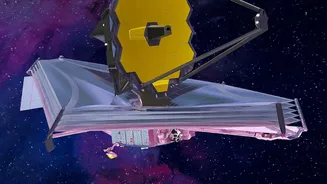
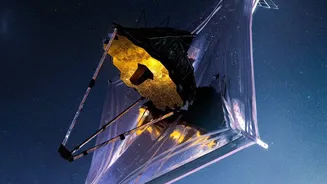
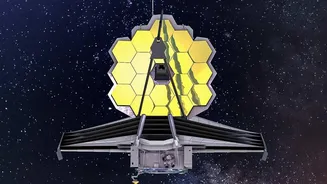
Enter the James Webb Space Telescope. Launched as a successor to the Hubble, the JWST is the most powerful space observatory ever built. Its massive, gold-plated mirror and advanced infrared instruments allow it to peer deeper into space and with greater sensitivity than ever before. One of its key missions is to analyse the atmospheres of exoplanets, a task for which it is uniquely designed. This capability is now turning the abstract idea of distant worlds into tangible places with discernible climates and chemistry, as recent findings show.
How to 'See' Water from Light-Years Away
Webb doesn’t “see” water in the way a camera takes a picture. Instead, it uses a technique called transmission spectroscopy. When an exoplanet transits, or crosses in front of its star from our perspective, a tiny fraction of the starlight filters through the planet's atmosphere. Different molecules in that atmosphere absorb specific colours, or wavelengths, of light. Water vapour, for example, leaves a very distinct chemical fingerprint in the light's spectrum. By capturing this filtered starlight and breaking it down into its constituent colours, JWST can identify the telltale signs of molecules like water, methane, and carbon dioxide.
A Breakthrough Discovery
In a recent observation cycle, Webb pointed its instruments at a distant exoplanet system and found the unmistakable signature of water vapour. Discoveries like this have been made on several planets, including the rocky planet GJ 486 b and the 'mini-Neptune' GJ 1214 b. In the case of GJ 1214 b, which is shrouded in a thick haze, Webb's infrared eyes were able to penetrate the clouds and detect that its atmosphere likely contains a significant amount of water vapour. While this planet is too hot for liquid oceans, the confirmation that a world like this can hold onto a water-rich atmosphere is a massive breakthrough. Scientists remain cautious, as sometimes the water signal can come from cool spots on the host star itself, but the data represents a major step forward.
The Crucial Ingredient for Life
The search for extraterrestrial life is, in many ways, a search for water. It is the one ingredient considered indispensable for life as we know it, acting as a universal solvent that enables the complex chemical reactions inside living cells. Finding water vapour in an exoplanet's atmosphere doesn’t guarantee the presence of life, but it's the most critical first checkmark on the list of habitability. It proves that one of the key building blocks for life exists beyond Earth. The discovery on a planet like K2-18b, which orbits within its star's 'habitable zone' where liquid water could potentially exist, was a landmark moment for this reason.
Just the Beginning of the Search
This detection is more than just a single discovery; it's a powerful demonstration of Webb's capabilities. It proves that we now have the technology to analyse the atmospheres of worlds light-years away. Every new detection helps astronomers refine their models of how planets form and evolve. The focus now shifts to finding this signature on smaller, rockier, more Earth-like planets. This isn't the end of the search for habitable worlds, but rather the end of the beginning. We have officially entered a new era of exploration, one where we can systematically take atmospheric roll calls across the galaxy, looking for worlds that might just feel a little like home.