







First, What Is a Skyrmion?
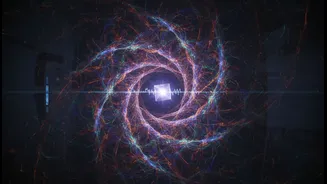
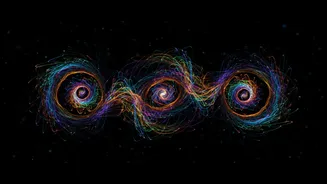
Before we get to the 'optical' part, let's start with the original concept. First proposed in the 1960s for particle physics, a skyrmion is a stable, particle-like knot or swirl in a field. Think of it like a tiny, self-contained whirlpool that doesn't
easily unravel. For decades, the most studied examples were in magnetic materials, where these nanoscale swirls in the magnetic field were seen as a promising way to store data. Their tiny size and topological stability—meaning their structure is robust and hard to accidentally erase—make them ideal for creating ultra-dense and energy-efficient memory. The core idea is that this unique, stable shape can be used to represent a bit of information.
The Leap from Magnetism to Light
The major shift happened when scientists figured out how to create these same topological patterns not with magnetic fields, but with light itself. An optical skyrmion is a nanoscale, swirling pattern of light, where properties like polarization and phase are carefully arranged to form a knot-like structure. This was a game-changer. While magnetic skyrmions are tied to a material surface, optical skyrmions can be created in free space, allowing them to propagate and carry information over distances. This opened up applications far beyond static data storage, pointing toward new forms of optical communication and processing.
The Promise of Unprecedented Technology
So, why the excitement? The unique properties of optical skyrmions could unlock a new generation of technologies. Because they are made of light, they can be manipulated at incredible speeds, promising all-optical logic and computation that would be much faster than current electronics. Their ability to be packed densely means they could lead to next-generation data storage solutions. Furthermore, their stability makes them robust carriers of information, which is a key requirement for quantum technologies, including secure communication and computing. Researchers are also exploring their use in high-resolution imaging, potentially overcoming the traditional limits of light microscopes to see things on a much smaller scale.
Making Them Is Getting Easier
For a while, creating optical skyrmions was a complex and expensive process, often requiring specially engineered microscopic structures called metamaterials to manipulate light in just the right way. This limited their accessibility for widespread research. However, a recent breakthrough has changed the landscape. Scientists at Nanyang Technological University in Singapore discovered a much simpler method using a 200-year-old physics phenomenon known as the Poisson spot. By simply shining a laser at a tiny circular object, they were able to generate stable optical skyrmions, drastically lowering the barrier to entry for studying and experimenting with them. This development is expected to accelerate research and innovation in the field.
Challenges and the Road Ahead
Despite the immense potential, the field is still in its early days. Researchers are working to overcome several challenges, including how to precisely control, manipulate, and read these light structures on a massive scale. Another key area of research is transferring the topological information from an optical skyrmion into matter—for instance, imprinting its structure onto a cloud of atoms—and then retrieving it. Successfully storing and retrieving these light-based patterns is a critical step for realizing applications in information storage and processing. As with any fundamental scientific discovery, the journey from the laboratory to a commercial product is long, but the foundational work being done now is paving the way for future breakthroughs.