








The Old Rulebook: A Calorie Is a Calorie
We have been taught to think about food in terms of numbers. We count calories, track macronutrients, and follow the simple logic that to manage weight, you must burn more calories than you consume. This model has been the foundation of nutritional advice
for generations. While it holds a basic truth, many find that it doesn't always work as predicted. People can follow the same diet with vastly different results, leading to frustration and the feeling that some hidden factor must be at play. This has pushed scientists to look beyond the 'what' and 'how much' of eating and to ask a different question: what about 'when'?
Meet Chrononutrition: Your Body’s Clock
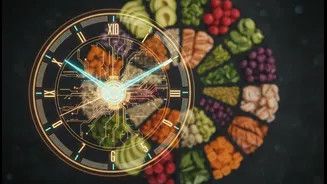
Enter the emerging field of chrononutrition. It's a scientific approach that studies the interaction between when we eat and our body's internal 24-hour clocks, known as circadian rhythms. These rhythms govern nearly all of our physiological functions—from our sleep-wake cycles and hormone production to our body temperature and, crucially, our metabolism. The central idea of chrononutrition is that our bodies are not designed to process food with the same efficiency at all hours of the day. By aligning our eating patterns with these natural rhythms, we might be able to improve our metabolic health, manage weight more effectively, and even reduce the risk of chronic diseases.
How Timing Affects Your Metabolism
Your body has a 'master clock' in the brain, which is synced primarily by light, but every organ, including your liver, pancreas, and gut, has its own peripheral clock. These clocks help prepare your body for expected events, like eating during the day and resting at night. During daylight hours, your body is primed for food. Insulin sensitivity is higher, meaning your cells are more responsive to taking up glucose from your bloodstream for energy. Digestion is more efficient. As evening approaches, your body's systems begin preparing for a period of fasting and repair. Insulin sensitivity decreases, and your digestive system slows down. Eating a large meal late at night forces your body to handle a flood of nutrients when it is least prepared to do so, which can lead to higher blood sugar, increased fat storage, and over time, metabolic disruption.
Time-Restricted Eating in Practice
One of the most popular applications of chrononutrition is time-restricted eating (TRE), often associated with intermittent fasting. Instead of focusing on calorie reduction, TRE involves consuming all of your daily food within a specific, consistent window of time, typically between 8 to 12 hours, and fasting for the remaining 14 to 16 hours. For example, a person might eat all their meals between 8 AM and 6 PM. This approach isn't about skipping meals but rather consolidating them into the body's active phase. The goal is to give the digestive system a long, predictable break overnight, allowing the body to switch from burning glucose to burning fat and to engage in important cellular cleanup processes.
The Evidence and The Promise
Research into chrononutrition is still growing, but the results are promising. Studies, many in animals but increasingly in humans, suggest that aligning meals with circadian rhythms can lead to several benefits. These include improved insulin sensitivity, lower blood pressure, reduced inflammation, and better weight management, sometimes even without a deliberate reduction in calories. A recent study from July 2026 noted that even a 12-week period of time-restricted eating could help sustain weight loss effects a year later. However, it's important to be realistic. Much of the research is ongoing, and results can be mixed. Some studies show that combining TRE with nutritional guidance yields the best results. It's not a magic bullet, but a powerful tool to complement a healthy diet.