




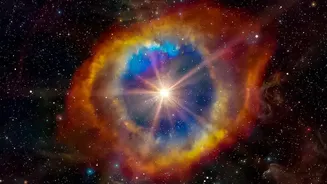
While all stars eventually run out of fuel, the most massive ones don't fade away quietly. Their deaths are some of the most violent and spectacular events in the cosmos, rewriting the laws of physics and seeding the universe with new elements.
A Life of Cosmic Pressure
A massive
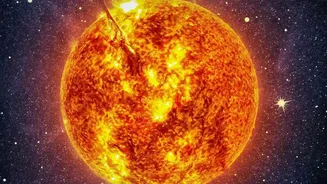
star, one with at least eight times the mass of our Sun, lives a fast and furious life. For millions of years, it exists in a delicate balance. The immense force of gravity constantly tries to crush the star, while the incredible energy from nuclear fusion in its core pushes outward, holding collapse at bay. In this stellar furnace, hydrogen atoms are fused into helium, releasing enormous amounts of light and heat. But this high-energy lifestyle means they burn through their fuel much more quickly than smaller stars. When the hydrogen in the core is exhausted, the star begins fusing helium into heavier elements like carbon and oxygen, moving up the periodic table in a desperate attempt to keep the lights on.
The Inevitable Collapse
This process of creating heavier and heavier elements continues until the star’s core is mostly iron. Unlike the lighter elements, fusing iron doesn't release energy; it consumes it. With its energy source gone, the star loses the battle against gravity. The outward pressure vanishes, and the core collapses catastrophically in a fraction of a second. The outer layers of the star, now with nothing to support them, come crashing down at speeds reaching a significant fraction of the speed of light, slamming into the newly-formed, ultra-dense core.
The Classic Supernova and the Neutron Star
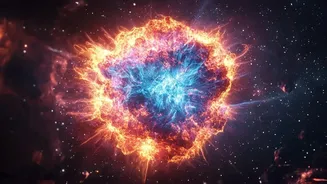
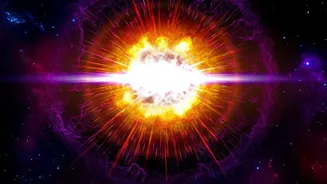
For many massive stars (those roughly 8 to 25 times the Sun's mass), this collapse triggers a spectacular explosion known as a Type II supernova. The infalling material rebounds off the dense core, creating a powerful shockwave that rips the star apart, for a time outshining entire galaxies. What's left at the center is a neutron star—an object so dense that a teaspoon of its material would weigh billions of tons. The star's core, once thousands of kilometers wide, is crushed into a spinning sphere only about 20 kilometers in diameter. This explosion scatters heavy elements forged inside the star across space, providing the raw materials for new stars and planets.
The Black Hole Finale
If the original star is even more massive (generally over 25 times the Sun's mass), gravity's victory is absolute. When the core collapses, the crush is so intense that not even the formation of a neutron star can stop it. The core continues to collapse until it becomes a black hole—an object with gravity so powerful that nothing, not even light, can escape. In some of these cases, the supernova explosion might still occur, blasting the star's outer layers into space while leaving a black hole behind. However, some theories and observations suggest that the most massive stars might collapse directly into a black hole with little to no visible explosion, a 'quiet' disappearance from the cosmos.
Hypernovae and Other Exotic Ends
The universe always has more extreme examples. For the truly colossal stars, those over 30 times the mass of the Sun, the end can be a hypernova. These are explosions that can be 10 to 100 times more powerful than a standard supernova and are linked to the formation of rapidly spinning black holes. Another exotic death is the pair-instability supernova, theorized for stars between 130 and 250 solar masses. In these giants, the core becomes so hot that energy turns into matter and antimatter, destabilizing the star and leading to a thermonuclear explosion that blows it completely apart, leaving no remnant—no neutron star, no black hole—behind.