


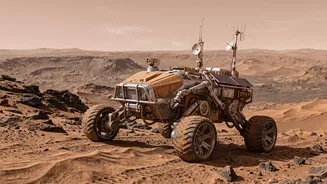


As robotic rovers like Perseverance rack up unprecedented mileage and scientific discoveries on Mars, a critical question sharpens: are these machines enough, or is the next great leap for mankind a human footprint on the Red Planet?
The Robotic Vanguard on Mars
For decades, robotic
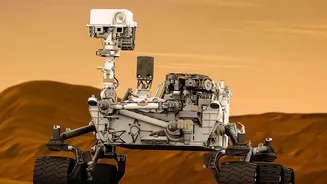
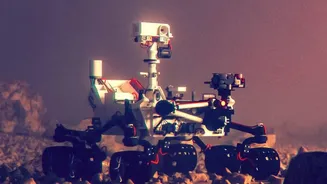
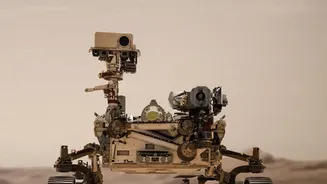
envoys have been our eyes, ears, and hands on Mars. From the early Sojourner to the long-lived Spirit and Opportunity, and now the highly advanced Curiosity and Perseverance rovers, these machines have fundamentally reshaped our understanding of the planet. Just this month, Perseverance set a new off-world driving record, having traversed over 45 kilometres of harsh Martian terrain since its landing in 2021. These robots are not just accumulating distance; they are producing groundbreaking science. Perseverance has identified igneous rocks altered by water in at least three different periods, suggesting a far more complex aquatic history for Jezero Crater than previously imagined. It has also uncovered potential biosignatures—possible signs of ancient microbial life—and is caching rock samples for a future return mission to Earth. With advanced autonomous navigation systems, rovers can now 'think while driving', planning their own routes to cover more ground safely and efficiently than ever before.
The Irreplaceable Human Element
Despite the undeniable success of rovers, proponents of crewed missions argue that robots are no substitute for human intuition and adaptability. A human geologist could accomplish in minutes what a rover might take weeks to do, such as digging a trench or breaking open a promising rock. Astronauts can react to unexpected discoveries in real-time without the significant communication delay between Earth and Mars, which can be as long as 22 minutes each way. This allows for spontaneous investigation and hypothesis-driven science on the fly. Proponents point to instances like the Apollo missions, where astronauts made impromptu decisions that led to key discoveries—actions a pre-programmed robot could never take. The primary scientific goals for sending humans are to conduct in-depth searches for life, understand the planet's evolution, and assess if humanity could one day establish a permanent presence there.
The Towering Cost and Unacceptable Risk
The single greatest argument against sending humans to Mars is the staggering cost and immense risk. Estimates for a single crewed mission range wildly, from optimistic figures around $100 billion to as high as half a trillion dollars. This is an order of magnitude greater than even the most sophisticated robotic mission. The expense comes from the need for life support systems, food, water, and robust radiation shielding for a round trip that could last up to three years. Beyond the financial toll is the human one. Astronauts would be exposed to deep-space radiation, bone density loss, muscle atrophy, and immense psychological stress from prolonged isolation. Unlike a lost rover, a failed human mission would be a catastrophic loss of life, a risk that many argue is too high when robots can perform much of the same work safely.
A Partnership for the Future
Ultimately, the debate may not be a true 'either/or' scenario. The most likely future for Mars exploration involves a symbiotic relationship between humans and robots. NASA's current strategy uses robotic missions as essential precursors to pave the way for human explorers. Rovers and orbiters map the terrain, identify resources like subsurface water ice, and scout potential landing sites. In the future, robots could be deployed ahead of a human crew to build habitats, pre-position supplies, and handle dangerous or repetitive tasks. Improved AI will make these robotic partners even more autonomous and capable. NASA's Artemis program, which aims to return humans to the Moon, is explicitly a testing ground for the technologies and procedures needed for an eventual crewed mission to Mars, planned for as early as the 2030s.