


The Textbook Definition
For generations, the distinction seemed simple. Asteroids were rocky, inert bodies, chunks of cosmic rubble left over from the formation of the planets. Most of them live in the main asteroid belt, a vast, doughnut-shaped ring between the orbits of Mars
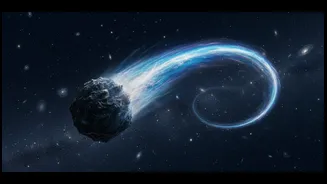
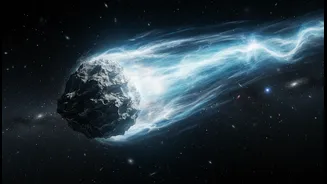
and Jupiter. Comets, on the other hand, were the solar system's 'dirty snowballs'—amalgams of ice, rock, and dust originating from the frigid outer reaches, like the Kuiper Belt or the distant Oort Cloud. When their long, looping orbits bring them close to the Sun, the ice vaporizes, creating a glowing halo called a coma and often a spectacular tail of dust and gas.
An Identity Crisis in the Asteroid Belt
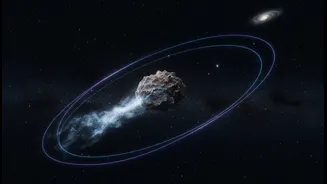
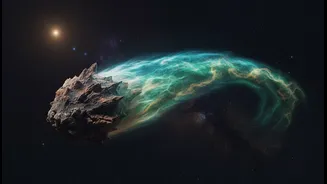
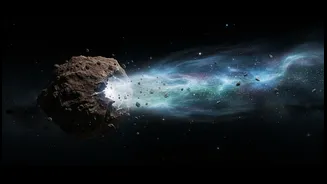
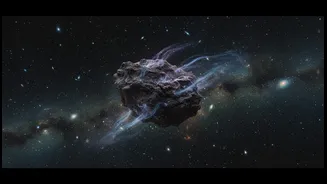
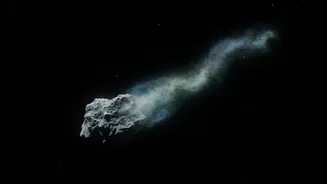
The neat division began to crumble with the discovery of objects that refused to fit in. Astronomers started finding celestial bodies that had the orbit of an asteroid—circling the Sun within the main belt—but exhibited the classic visual characteristics of a comet, like a coma or tail. These puzzling objects were first called 'main-belt comets,' but the term has evolved to 'active asteroids.' There are now dozens of these known, and they've become a hot topic of research. The first to be identified was an object discovered in 1979, which seemed like a typical asteroid for years. Then, in 1996, it was spotted with a faint tail, earning it a dual designation as both asteroid 7968 Elst-Pizarro and comet 133P/Elst-Pizarro.
What Makes an Asteroid 'Active'?
An asteroid sprouting a tail isn't always because of melting ice. While the sublimation of previously hidden water ice is a leading theory, it's not the only explanation. Sometimes, activity can be triggered by a collision, where a smaller object slams into an asteroid and kicks up a massive debris cloud that mimics a tail. Another cause can be rotational instability; if an asteroid spins fast enough, the centrifugal force can overcome its own gravity, causing it to shed dust and rock into space. Astronomers have also seen asteroids, like 3200 Phaethon, brighten and shed dust due to thermal fracturing as they get intensely heated by the Sun, cracking like a mud flat. Each active asteroid is a detective case, requiring careful observation to determine the cause of its transformation.
The Blurring Lines of Classification
These discoveries have led to a more nuanced understanding. Instead of two distinct categories, we now see a continuum. There are rocky asteroids, icy comets, and a fascinating grey area of objects in between. Some objects may be 'burned-out' comets that have lost all their easily vaporized ice after many trips around the Sun, now masquerading as asteroids. Others, like the main-belt comets, suggest that ice might be more common in the warmer, inner solar system than previously thought. This has huge implications, not just for classification but for understanding our own origins. The International Astronomical Union even created a broader category in 2006 called 'Small Solar System Bodies' to encompass asteroids, comets, and anything else that isn't a planet or dwarf planet.
Why These Labels Still Matter
If the lines are so blurry, why bother with the labels at all? Because an object’s classification tells a story about its origin and history. Knowing whether an object is an icy body from the solar system's edge or a rocky fragment from the asteroid belt provides clues about the conditions in which it formed billions of years ago. These small bodies are essentially time capsules. Studying their composition helps scientists piece together the puzzle of how our solar system was built and how materials like water—a key ingredient for life—were distributed. Active asteroids in the main belt, for instance, are particularly exciting because they might be a sample of the kind of icy bodies that could have delivered water to the early Earth.