

An Ambitious Mission to a Mysterious Planet
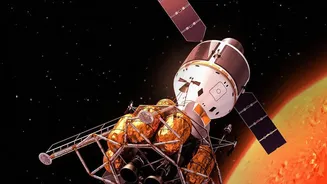
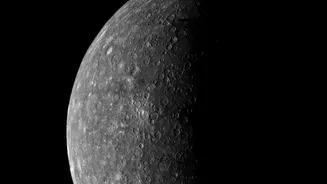
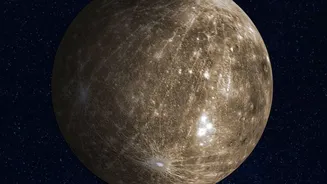
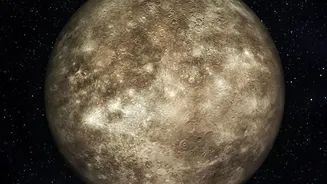
BepiColombo is a landmark joint mission between the European Space Agency (ESA) and the Japan Aerospace Exploration Agency (JAXA). It is only the third mission to visit Mercury, following NASA's Mariner 10 and MESSENGER probes. The mission comprises two
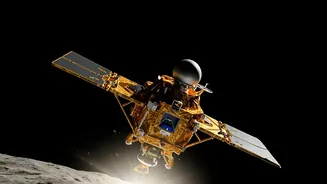
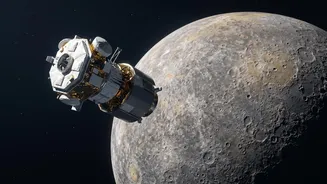
specialized science orbiters that travel together: ESA’s Mercury Planetary Orbiter (MPO) and JAXA’s Mercury Magnetospheric Orbiter, named Mio. Together, they will conduct the most comprehensive study of Mercury to date, examining everything from its cratered surface and surprisingly dense interior to its magnetic field and interaction with the sun.
The Long and Winding Road
Getting to Mercury is incredibly difficult. A direct flight would cause a spacecraft to accelerate dangerously in the Sun's immense gravity. To counter this, BepiColombo embarked on a complex, eight-year journey after its launch in October 2018. The mission has relied on nine planetary flybys—one of Earth, two of Venus, and six of Mercury itself—to use the planets' gravity to slow down and adjust its path. This fuel-efficient technique, known as a gravity assist, was pioneered by the mission's namesake, Italian scientist Giuseppe 'Bepi' Colombo. This long voyage, made more complex by a thruster issue that delayed arrival from 2025 to 2026, has been one of the most complicated interplanetary trajectories ever flown.
The Critical Separation
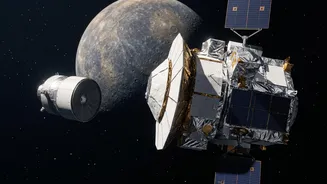
On September 3, 2026, the mission reached a pivotal moment: the separation of the Mercury Transfer Module (MTM). For nearly eight years, the MTM served as the powerhouse for the stacked spacecraft, providing propulsion and power with its large solar arrays. Having completed its job of getting the science orbiters to Mercury, the MTM was jettisoned. The successful separation, confirmed by signals received at control centers on Earth, marked the official start of the mission's 'arrival phase'. With the MTM gone, the two science orbiters, still connected, began their final approach powered by the MPO.
Entering Mercury's Orbit
Arriving at Mercury isn't a single event but a months-long process. On November 21, 2026, the combined MPO and Mio spacecraft will be gently captured by Mercury's gravity, entering a wide, looping orbit. This marks the official orbital insertion. However, the work is far from over. A sequence of 16 delicate engine burns will then begin, progressively lowering and reshaping the orbit over several months. This gradual approach is necessary to achieve the precise, stable orbits required for the science phase.
Two Spacecraft, Two Orbits
The final major step is the separation of the two science orbiters. Around December 9-10, 2026, JAXA's Mio will separate from ESA's MPO. Mio will settle into a highly elliptical orbit, allowing it to study Mercury's magnetic field and magnetosphere. MPO will then jettison the sunshield that protected Mio during the cruise phase and continue to fine-tune its own path, eventually settling into a much closer, circular orbit to map the planet's surface and interior. With both spacecraft in their dedicated orbits, the main science mission is scheduled to begin in April 2027.