




What Is a Planetary Alignment?
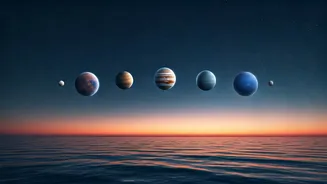
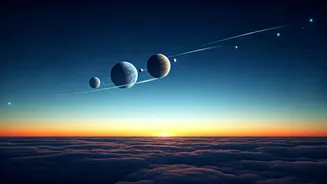
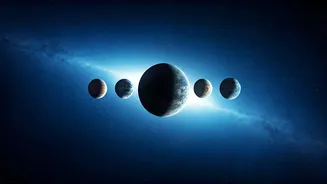
Before you rush outside, let's quickly understand what's happening. The term "planetary alignment" might bring to mind images of planets forming a perfectly straight line in space, but the reality is a bit different and, frankly, more of a beautiful illusion.
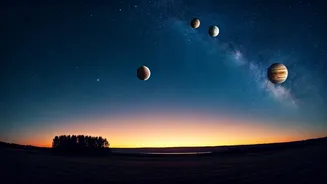
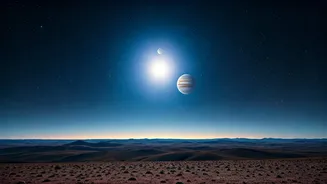
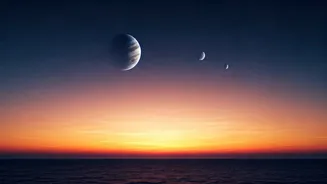
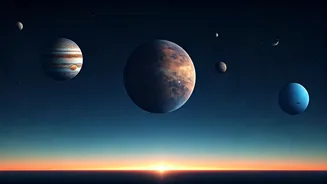
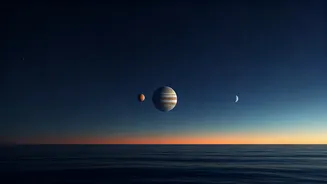
What we're witnessing is a visual grouping from our perspective here on Earth. The planets in our solar system are all orbiting the Sun on slightly different paths and at different speeds. Occasionally, from our viewpoint, two or more planets appear to pass close to each other in the sky. Astronomers often call this a 'conjunction' or a 'grouping.' Tonight’s event sees three planets—bright Jupiter, speedy Mercury, and distant Uranus—creating a lovely celestial triangle in the evening twilight.
When and Where to Look in India
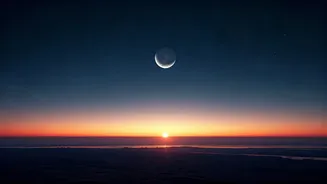
This is the most important part! Timing is everything for this cosmic show. The best time to look is roughly 45 to 75 minutes after sunset, no matter where you are in India. As the sky darkens from a deep blue to an inky black, look towards the western horizon—the same direction where the Sun just set. The planets will be relatively low in the sky, so you’ll need a clear, unobstructed view without tall buildings or trees blocking your line of sight. The show won't last long; the planets will follow the Sun and dip below the horizon within a couple of hours, so make sure you don’t miss the window.
Identifying the Celestial Trio
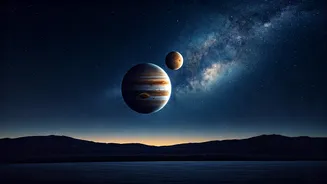
So, how do you know what you’re looking at? The brightest point of light in the trio will be Jupiter. It will shine with a steady, brilliant white light, impossible to miss. It's the king of the planets and it certainly looks the part. Just below Jupiter and slightly to its right, you might spot a much fainter dot of light—that's Mercury. It's the smallest planet and hugs the Sun's glare, so it's always a challenge to spot. The third planet, Uranus, will be the trickiest. It will be located slightly above Jupiter but is too faint to be seen with the naked eye from most cities. However, if you have a pair of binoculars, you're in for a treat. Scan the area just above Jupiter, and you might spot a tiny, pale blue-green dot. That’s the ice giant, nearly 300 crore kilometres away!
Tips for the Best Viewing Experience
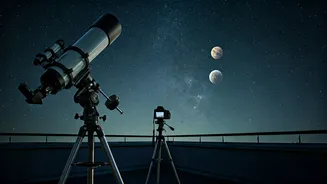
You don't need expensive equipment to enjoy this. First, find a spot with as little light pollution as possible. A park, a terrace, or even the outskirts of your town will be much better than a brightly lit street. Second, give your eyes time to adjust. It takes about 15-20 minutes for our eyes to fully adapt to the dark and see fainter objects. Avoid looking at your phone screen, as its bright light will ruin your night vision. A pair of standard binoculars will dramatically enhance your view, making Mercury easier to spot and revealing Uranus as a distinct point of light. Finally, get comfortable. Stargazing is a patient activity, so bring a chair or a mat to lie on.
Can I Photograph This With My Phone?
Yes, you can! While you won't get a NASA-level shot, you can definitely capture a memento. Most modern smartphones have a 'Night Mode' or 'Pro Mode' in their camera app. Use it. Instead of hand-holding your phone, try to stabilize it. Prop it up against a wall, a bag, or use a small tripod. This prevents the blurry star trails caused by shaky hands. Tap on Jupiter on your screen to set the focus. Don't use the digital zoom—it just degrades the image quality. You might not capture all three planets clearly, but you should be able to get a lovely shot of the twilight sky with brilliant Jupiter as the star of the show.