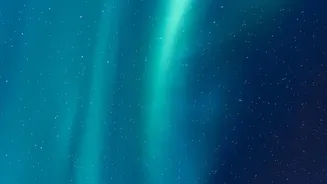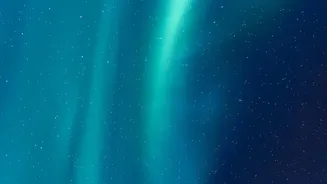


The shimmering, dancing lights of the aurora are one of nature's most spectacular displays. But this celestial ballet is not magic—it's a beautiful, large-scale physics experiment. So, what exactly causes these vibrant curtains of light?
A Cosmic Collision Course
The story of the
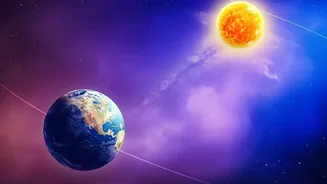
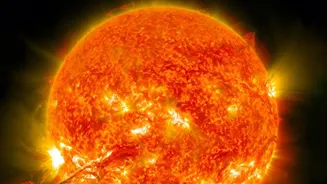
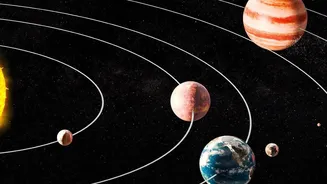
aurora begins 150 million kilometres away, at the Sun. Our star constantly emits a stream of charged particles—mostly electrons and protons—known as the solar wind. This solar wind travels across space, and when it reaches Earth, it encounters our planet’s magnetic field, the magnetosphere. The magnetosphere acts like a protective shield, deflecting the majority of these particles. However, the magnetic field lines funnel some of these energetic particles towards the North and South Poles. This is why auroras are typically only seen in high-latitude regions, in areas known as the auroral ovals.
The Science of the Glow
As these high-energy particles are channelled into the upper atmosphere, they collide with gas atoms and molecules, primarily oxygen and nitrogen. This collision is the key to the light show. The process is similar to how a neon sign works. The impact transfers energy to the atmospheric atoms, putting them in an 'excited' state. But this state is unstable, and the atoms quickly release the excess energy to return to their normal state. That released energy takes the form of tiny packets of light, called photons. When billions of these collisions happen at once, they create the moving, glowing spectacle we see as the aurora.
Green: The Aurora's Signature Colour
The most common colour seen in an aurora is a brilliant green. This specific shade is produced when the charged particles collide with oxygen atoms at altitudes between 100 and 300 kilometres. Oxygen is abundant at this height, and our eyes are particularly sensitive to this greenish-yellow wavelength of light, making it the most visible and frequently observed auroral hue. So when you see those classic, shimmering green ribbons, you're witnessing the signature glow of excited oxygen in the mid-level upper atmosphere.
Red: A Rare, High-Altitude Blush
Seeing a red aurora is a much rarer treat and usually only occurs during periods of intense solar activity. Like green, red light is also produced by oxygen atoms, but the magic happens at much higher altitudes—typically above 300 kilometres. Up in this thinner part of the atmosphere, the process for oxygen to release a red photon takes much longer. At lower altitudes, the oxygen atom would likely collide with another particle before it has the chance to emit red light. But in the sparse, high-altitude environment, it has enough time to complete the process, creating a crimson glow high above the more common green displays.
The Blues, Purples, and Pinks
While oxygen paints the sky green and red, nitrogen is responsible for the cooler tones. Collisions with nitrogen molecules can produce blue and violet light. These colours often appear at the lower edges of the auroral curtains, typically below 100 kilometres, and require highly energetic particles to penetrate that deeply into the atmosphere. Pinks and magentas are often a mix of colours. A pinkish fringe at the bottom of a green curtain, for instance, is the result of blue and red light from nitrogen mixing together. These colours are generally fainter and harder for our eyes to see, but they signal very energetic solar activity.