







The Universe's Natural Clocks
Pulsars are one of nature's most fascinating creations. They are the super-dense, spinning remnants of massive stars that have gone supernova. A pulsar is a type of neutron star that is highly magnetic and rotates at incredible speeds, sometimes hundreds
of times per second. As it spins, it shoots out beams of radiation, typically from its magnetic poles. From our perspective on Earth, these beams sweep across space like a lighthouse, and we detect them as regular, predictable pulses. It was this clock-like regularity that first stunned astronomers, who have since discovered over 3,000 of them. This precision makes certain types of pulsars, known as millisecond pulsars, as stable as atomic clocks, which are the basis for our own GPS systems.
Building the Galactic GPS
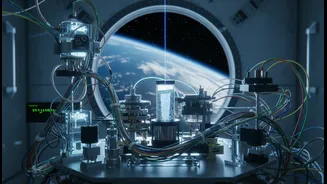
For years, the idea of using these cosmic beacons for navigation was just a theory. NASA turned it into a proven concept with an experiment called SEXTANT (Station Explorer for X-ray Timing and Navigation Technology). Operating from the International Space Station (ISS), an instrument named NICER (Neutron star Interior Composition Explorer) was used to detect X-ray signals from a selection of pulsars. By measuring the precise arrival times of these X-ray pulses, the SEXTANT system could determine its own position in space autonomously, without any help from Earth. In a landmark 2018 demonstration, the system successfully tracked the ISS, which orbits at over 28,000 kilometres per hour, and pinpointed its location to within a few kilometres. This was the first time X-ray navigation was demonstrated in real-time in space, proving that a 'galactic positioning system' is feasible.
The Impact on Deep Space Exploration
The success of pulsar navigation is a game-changer for future space missions. Currently, spacecraft in deep space rely on the Deep Space Network (DSN) on Earth for navigation instructions. This process is slow; a signal to the Voyager 1 probe can take nearly a day to travel one way. This communication lag makes real-time, autonomous navigation impossible. Pulsar navigation solves this problem. A spacecraft equipped with an X-ray detector could calculate its own position and trajectory instantly, whether it's on the far side of the Moon, orbiting Mars, or journeying to the outer planets like Jupiter and beyond. This autonomy would reduce the strain on the DSN and allow for more complex missions, such as robotic exploration fleets in the asteroid belt or missions beyond our solar system.
Remaining Questions and Hurdles
While the SEXTANT demonstration was a major success, there are still challenges to overcome before pulsar navigation becomes a standard feature on spacecraft. One major goal is to improve accuracy and create a more comprehensive database of suitable pulsars. Scientists need to find the optimal combination of pulsars whose signals provide stable and precise performance. The technology also needs to be refined. The current detectors are still relatively large and power-intensive for smaller probes. Future work will focus on miniaturising the sensors, reducing power needs, and increasing their sensitivity to detect fainter pulsar signals. Additionally, while pulsars are incredibly stable, they are not perfect clocks and can sometimes exhibit 'glitches' or timing noise that must be accounted for in navigation algorithms. Overcoming these hurdles will be key to making this technology a robust and reliable tool for all future space explorers.