

A Tiny Dot, A Giant Puzzle
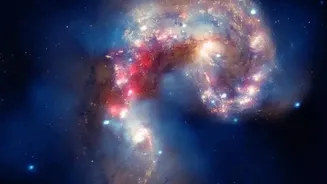
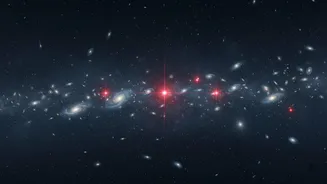
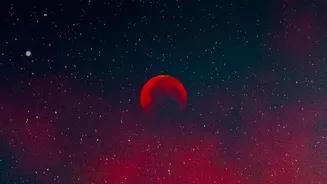
Imagine looking at the most profound image of deep space ever taken. It’s filled with galaxies of all shapes and sizes. And then you spot it: a tiny, faint, reddish smudge. This is the essence of what astronomers are calling 'Little Red Dots,' a class
of objects being discovered by the JWST. These are not just any celestial bodies; they appear to be some of the most distant and therefore earliest objects ever seen. One recent study has focused on a particular dot, which seems to exist at a time when the universe was in its infancy. The initial analysis caused a stir, with some calling them 'universe breakers' because they seemed too massive to have formed so early in cosmic history, defying existing models of galaxy formation. There simply wasn't supposed to be enough time or material for galaxies that large to come into existence.
Why Red Means Far Away
The 'red' in 'Little Red Dot' is the key to understanding its significance. It’s not just a colour; it’s a measurement. As the universe expands, it stretches everything within it, including waves of light. Light from a distant object travelling through expanding space gets stretched out, shifting its wavelength towards the red end of the spectrum. This phenomenon is known as 'cosmological redshift'. The greater the redshift, the farther away the object is and, crucially, the further back in time we are seeing it. The light from these dots has travelled for over 13 billion years to reach us. To see them, you need a powerful infrared telescope like the JWST, because the light that may have started as ultraviolet or visible has been stretched all the way to the infrared spectrum by the time it completes its epic journey.
Rewriting the First Chapter of the Universe
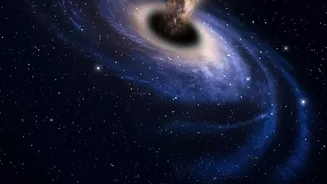
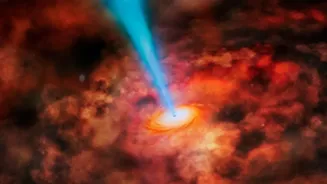
The discovery of these objects forces a major rethink of how the first galaxies came to be. The prevailing theory, known as the 'bottom-up' model, suggests that small collections of stars and gas clumps merged over vast periods to form the large galaxies we see today. But these Little Red Dots appear surprisingly bright and massive for their age. This has sparked a fascinating scientific debate. Are they really super-massive galaxies that formed impossibly fast? Or are they something else entirely? One compelling new theory suggests they might not be galaxies in the traditional sense, but a different kind of celestial object. Researchers have proposed they could be ravenously feeding supermassive black holes at the centre of young galaxies, so shrouded in gas and dust that they appear as a single, compact red object. This could explain their extreme brightness.
The Power of an Infrared Eye
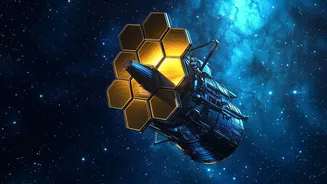
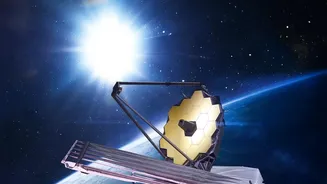
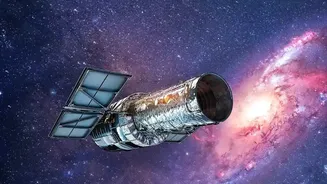
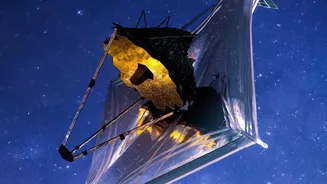
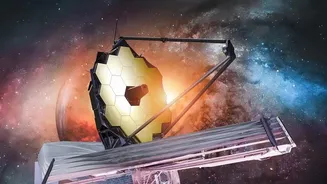
Finding these cosmic puzzles would be impossible without the specific capabilities of the James Webb Space Telescope. Its predecessor, the Hubble Space Telescope, gave us breathtaking views of the universe, but JWST is designed to see in infrared light. This allows it to peer through the cosmic dust that obscures many celestial objects and, most importantly, to detect the highly redshifted light from the dawn of time. Galaxies like 'Maisie's Galaxy,' one of the earliest confirmed galaxies seen by JWST, were found to exist just 390 million years after the Big Bang, something previously out of reach. The telescope's advanced spectrographs can split the faint light from these dots into a spectrum, allowing scientists to measure their redshift with incredible precision and confirm their immense distance.