



Gliding across the water is a fantastic way to exercise and explore, and two craft dominate the scene: kayaks and stand-up paddleboards. While both offer a great day out, they provide vastly different physical experiences. Here’s a closer look.
The Core Difference: Paddle and Posture
The most
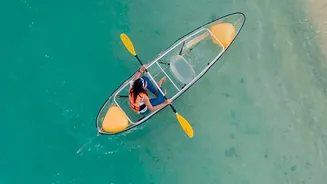
obvious distinction lies in your equipment and position. In a kayak, you are seated with your legs forward, using a double-bladed paddle. This low centre of gravity makes kayaks very stable, and the paddling motion is a consistent side-to-side rotation. Stand-up paddleboarding (SUP) puts you upright on a wider, flatter board, using a long, single-bladed paddle. This standing posture immediately engages your balance, turning the activity into a full-body stability challenge before you even take your first stroke. Your core and leg muscles are constantly working just to keep you steady on the water.
The Kayak Stroke: A Rotational Push-Pull
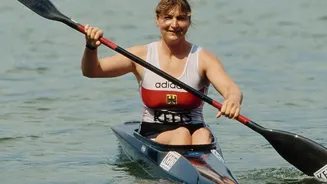
Proper kayaking technique is not about pulling with your arms. A powerful kayak stroke originates from your core. As you plant one paddle blade in the water near your feet, you rotate your torso, effectively pushing with your top hand while pulling with your bottom arm. This push-pull motion, driven by the large muscles of your back (lats) and core (obliques), creates a smooth, efficient glide. Your legs play a role, too, braced against footpegs to help transfer power from your torso rotation into each stroke. While your arms and shoulders are involved, they act more as a framework to hold the paddle, not as the primary engine.
The Paddleboard Stroke: A Full-Body Lever
The SUP stroke is a different beast entirely. You stand with feet parallel, reach forward with the paddle, and 'plant' the blade fully in the water. The power phase involves using your entire body as a lever. You engage your core and hinge at the hips, pulling the paddle through the water not by yanking with your arms, but by using your larger back muscles. Your arms should remain relatively straight. Because you alternate sides every few strokes, the movement is more symmetrical over the long run compared to canoeing. This technique provides a comprehensive workout, activating the muscles in your legs, glutes, core, back, and shoulders.
Power Source: Torso Twist vs. Total Body
The fundamental power source is a key differentiator. Kayaking is fundamentally a core and upper-body workout focused on rotational strength. The seated position isolates the upper body and torso, which do the majority of the work. In contrast, paddleboarding is a true full-body workout. Your legs and glutes are firing to maintain balance, your core is constantly engaged to provide stability and power the stroke, and your back, shoulders, and arms are all involved in the paddling motion. This is why paddleboarding is often cited as burning more calories per hour than recreational kayaking on calm water.
Shoulder Effort: The Real Story
Both sports carry a risk of shoulder strain if done with poor technique. However, the nature of the effort differs. In kayaking, the repetitive push-pull motion can lead to overuse injuries in the rotator cuff if you rely too much on your arms instead of your torso. The goal is to keep your elbows slightly bent and use your core to do the work, reducing direct strain on the shoulder joint. In paddleboarding, a common mistake is raising the top arm too high—above eye level—which can lead to shoulder impingement. Proper technique involves keeping the top hand lower to leverage core and back muscles, which protects the shoulder. Essentially, while both engage the shoulders, paddleboarding integrates them into a larger, full-body movement, whereas kayaking can isolate shoulder effort more if technique is poor.