
A Promising Planetary System
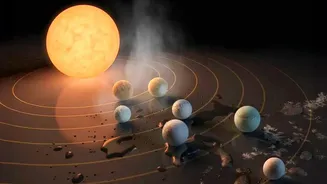
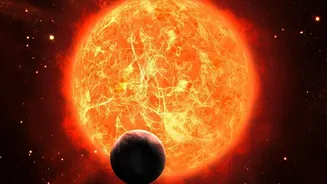
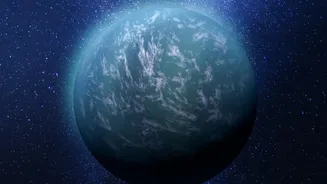
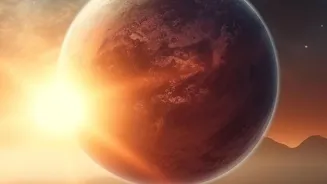
Located about 40 light-years from Earth, it's one of the most intriguing planetary systems ever discovered. It features seven rocky, Earth-sized planets orbiting a small, cool star known as an ultracool red dwarf. Because the star is much dimmer and cooler
than our sun, its 'habitable zone'—the region where temperatures could allow for liquid water—is much closer in. Several TRAPPIST-1 planets orbit within this zone, making them prime candidates for atmospheric study and the broader search for habitability. Ever since its discovery, scientists have been pointing our most advanced telescopes at this system, hoping to find out if any of these worlds have the right conditions for life. The big question has always been whether these planets, so close to their star, could hold onto an atmosphere at all.
Seeing the Unseen
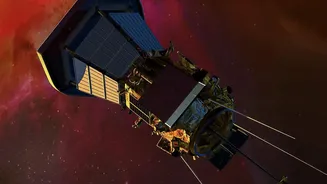
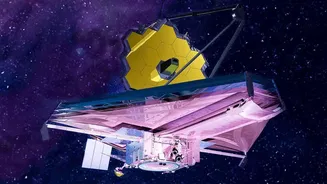
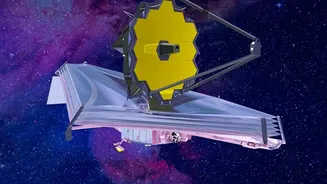
So how does the JWST study the atmosphere of a planet 40 light-years away? It uses a technique called transmission spectroscopy. When a planet passes in front of its star from our perspective (an event called a transit), a tiny fraction of the starlight filters through the planet’s atmosphere. Different gases in that atmosphere absorb light at specific wavelengths, leaving a unique chemical fingerprint, like a barcode, in the starlight that reaches the telescope. By analyzing this barcode, astronomers can determine what the atmosphere is made of. It's an incredibly precise measurement, looking for subtle dips in light. The JWST was designed specifically for this kind of work, with unprecedented sensitivity to the infrared light where molecules like carbon dioxide and methane leave their strongest signatures.
The Carbon-Rich Discovery
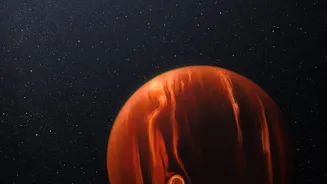
The latest study has focused on one of the planets in the TRAPPIST-1 system, revealing the presence of significant quantities of 'heavy' carbon-based gases, most likely carbon dioxide and methane. These are called 'heavy' to distinguish them from lighter gases like hydrogen and helium, which tend to escape into space more easily. Finding a substantial atmosphere rich in these heavier molecules is a game-changer. Previous observations of some of the innermost TRAPPIST-1 planets, like 1b and 1c, suggested they might be bare rock. This new finding on a different planet in the system suggests that at least some TRAPPIST-1 worlds were able to form and, more importantly, retain a significant atmosphere. The presence of carbon is itself a crucial ingredient, as it's the fundamental building block for life as we know it.
The Goldilocks Gas
Why are these carbon gases so crucial for habitability? It's all about the greenhouse effect. On Earth, carbon dioxide plays a vital role in trapping heat and keeping our planet's temperature stable and warm enough for liquid water and life. It acts like a planetary blanket. A planet without greenhouse gases would likely be a frozen, barren wasteland. However, it's a delicate balance. Too much carbon dioxide can lead to a runaway greenhouse effect, like on Venus, which has scorching surface temperatures. Finding a planet with a substantial but not runaway amount of CO2 is a key indicator that it might have a regulated climate. The detection of both carbon dioxide and methane could also be significant, as interactions between these gases can be influenced by geology or even biology.
A Step Closer, Not a Conclusion
It is essential to be clear: this discovery is not evidence of life. Rather, it is evidence of a potentially habitable environment. Think of it as scientists ticking another box on a long checklist. We've gone from finding a rocky, Earth-sized planet, to finding one in the habitable zone, and now to finding one with a carbon-rich atmosphere. Each step refines the search and tells us where to look more closely. This finding proves that a small rocky planet orbiting a red dwarf star can hold onto the kind of atmosphere that could support a stable climate. It provides a tangible target for future, even more detailed observations that will search for biosignatures—gases that are strongly indicative of biological processes. The story of TRAPPIST-1 is far from over; in fact, it's just getting started.