





A Messenger From Another Star
Our solar system is usually a closed club. Everything in it—planets, asteroids, and comets—was born here and is gravitationally bound to the Sun. But very rarely, an object from another star system pays a visit. 3I/ATLAS is the third such visitor ever
confirmed. The '3I' in its name literally means 'third interstellar object'. Its predecessors were 1I/ʻOumuamua, a mysterious, cigar-shaped object found in 2017, and 2I/Borisov, a more familiar-looking comet discovered in 2019. Like them, 3I/ATLAS is not in a closed orbit around our Sun. It’s following a hyperbolic trajectory, meaning it’s moving so fast that it will swing past the Sun and head back into deep space, never to return. Its journey through our system gives scientists a brief but precious window to study material forged around a different star.
The Discovery by ATLAS
The credit for the discovery goes to the Asteroid Terrestrial-impact Last Alert System, or ATLAS, a NASA-funded survey. Its network of telescopes in Chile, South Africa, and Hawaii automatically scans the sky every night, looking for moving objects. While its main job is to find potentially hazardous asteroids, it’s also great at spotting unusual visitors. On July 1, 2025, the ATLAS telescope in Chile flagged a new, faint object. Once its extreme speed and path were calculated, astronomers knew they had something special. It wasn't from here. Piecing together observations, researchers found that other telescopes had unknowingly captured images of the object as far back as June 14, 2025. This pre-discovery data was crucial for confirming its interstellar origin.
What Makes This Visitor Different
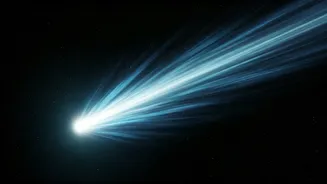
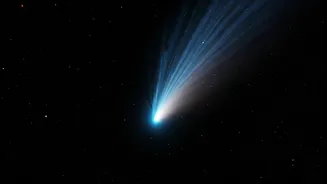
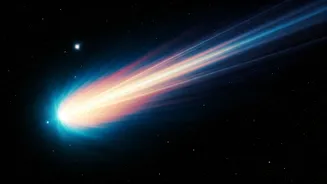
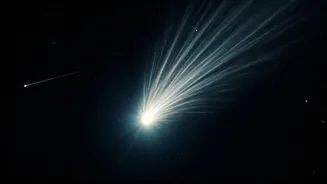
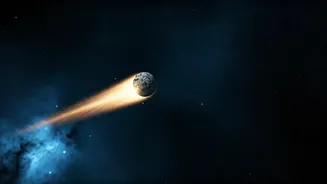
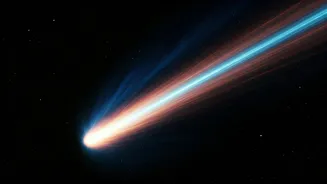
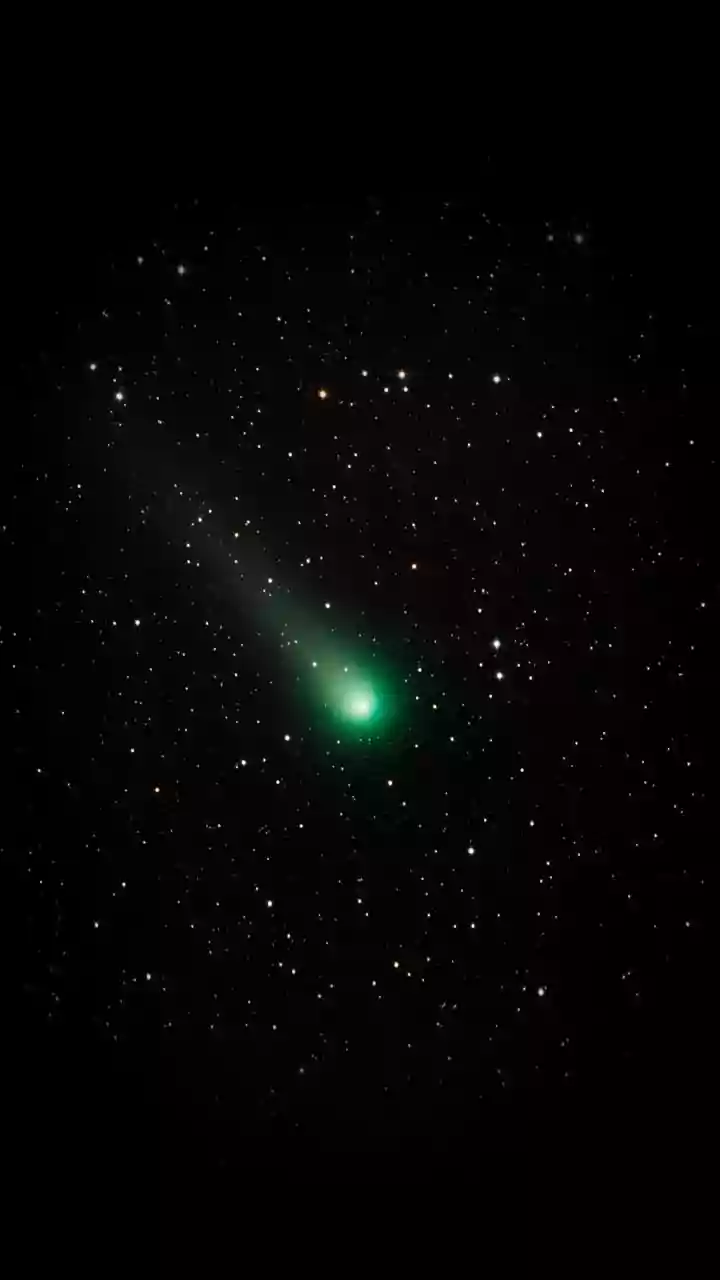
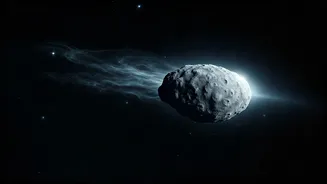
While ʻOumuamua was strange and rocky with no visible tail, and Borisov looked and acted much like a typical comet from our own system, 3I/ATLAS has its own unique characteristics. Observations show it is an active comet with a coma—a cloud of gas and dust—and a tail. Unlike Borisov, it appears to be unusually rich in certain volatile compounds, a chemical fingerprint that hints at its origins in a star system different from our own. Some studies even suggest it might be ancient, with models tracing its origin to a star system that formed up to 8.7 billion years ago, making it potentially older than our own Sun. This makes it a cosmic time capsule, carrying information about the chemistry of the galaxy from a much earlier era.
A Scientific Gold Rush
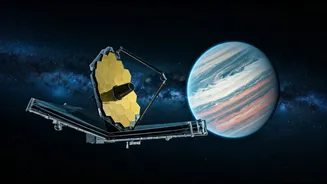
The discovery triggered a global scientific campaign. Astronomers scrambled to point every available telescope, from ground-based observatories to the Hubble and James Webb Space Telescopes, at the newcomer. Even spacecraft on other missions, like NASA's SPHEREx and ESA's Juice, were tasked with observing the comet. Each observation adds another piece to the puzzle. Scientists are studying the light from the comet to decode its composition, size, and rotation. These details can tell us about the building blocks of planets in its home star system. Preliminary results from NASA's SPHEREx mission detected organic molecules like methanol and methane, which are the foundations for complex chemistry. The fact that 3I/ATLAS seems to behave in some ways like our own comets suggests that the processes that form these icy bodies could be common across the galaxy.
Can You See It?
For amateur stargazers, 3I/ATLAS presented a challenging but possible target. The comet passed its closest point to the Sun on October 29-30, 2025, a point when it was hidden from Earth's view as it was on the opposite side of the Sun. It became visible again in the pre-dawn sky later in the year. According to NASA, it was observable with a small telescope through the spring of 2026 as it moved away from the Sun and back toward interstellar space. While it never posed a threat—its closest approach was about 170 million miles from Earth—its brief visibility was a reminder of the dynamic and interconnected nature of the galaxy. The comet is now on its way out, growing fainter as it recedes into the darkness from which it came.