







Saturn Takes Centre Stage
If you have a chance to look at only one planet this month, make it Saturn. The gas giant reaches opposition on October 4, 2026. Opposition is an astronomical event when Earth passes directly between the Sun and an outer planet. For us, this means Saturn rises
in the east around sunset, remains visible all night long, and sets in the west around sunrise, making it exceptionally convenient to observe. During this period, the planet is also near its closest point to Earth, appearing bigger and brighter than at any other time of the year. For observers in India, Saturn rises at approximately 6:11 pm, reaches its highest point just after midnight, and sets around 6:23 am the next morning, offering a generous 12-hour viewing window. While visible to the naked eye as a steady, bright point of light, even a small telescope will reveal its magnificent rings.
The Seeliger Effect: A Ringed Marvel
Something special happens around opposition that makes Saturn's rings appear even more brilliant: the Seeliger effect. The rings are made of countless icy particles that normally cast tiny shadows on each other. When the Sun is directly behind us, as it is during opposition, these shadows vanish from our line of sight. This causes the rings to reflect more sunlight back toward Earth, resulting in a noticeable surge in their brightness. While the effect is subtle to the naked eye, those with telescopes may notice the rings looking unusually luminous in the days surrounding October 4. The planet's rings are tilted at about 7.5 degrees toward Earth this month, offering a clear, though relatively narrow, view of their structure.
Morning Planets: A Predawn Dance
Early risers are in for a treat this October, with Mars and Jupiter putting on a show in the predawn sky. The two planets can be seen in the east before sunrise. On October 5, the waning crescent Moon will appear near reddish Mars. The following morning, October 6, the Moon will be close to the brilliantly bright Jupiter. Throughout the month, Mars will appear to move closer to Jupiter, setting the stage for an even closer encounter in November. On October 11, Mars will also pass through the Beehive star cluster, a sight best appreciated with a pair of binoculars.
October's Shooting Stars
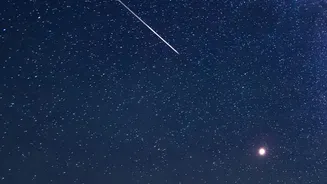
October hosts two meteor showers, though with mixed viewing prospects. First up are the Draconids, active from October 6-10 and peaking on the evening of October 8-9. This is an unusual shower best viewed in the early evening rather than after midnight. The good news for 2026 is that the peak occurs with an almost moonless sky, creating excellent conditions for spotting these typically slow-moving meteors. Expect a modest rate of about 5-10 meteors per hour. Later in the month, the Orionid meteor shower peaks on the night of October 21-22. These meteors are debris from the famous Halley's Comet and are known for being bright and fast. Unfortunately, a bright waxing gibbous Moon will be present for much of the night, washing out all but the brightest meteors. Your best chance to see them will be in the hours before dawn after the Moon has set.
Tips for the Best Viewing
To make the most of your October skywatching, a few simple tips can go a long way. For planets like Saturn, which are bright, viewing is possible even from a city. However, for fainter objects and meteor showers, finding a location away from bright city lights is crucial. Give your eyes about 15-20 minutes to fully adapt to the darkness; this will help you spot much fainter objects. While planets are easily visible with the naked eye, a good pair of binoculars can enhance the view of star clusters like the Beehive, and even a basic telescope can transform Saturn from a bright star into a world with visible rings. Remember to check the local weather forecast before you head out, as clear skies are essential for any astronomical viewing.