






A Cosmic Ghost Story
Imagine a star like our Sun reaching the end of its life. In about five billion years, it will swell into a monstrous red giant, consuming Mercury, Venus, and possibly Earth, before collapsing into a white dwarf — a dense, Earth-sized ember glowing with
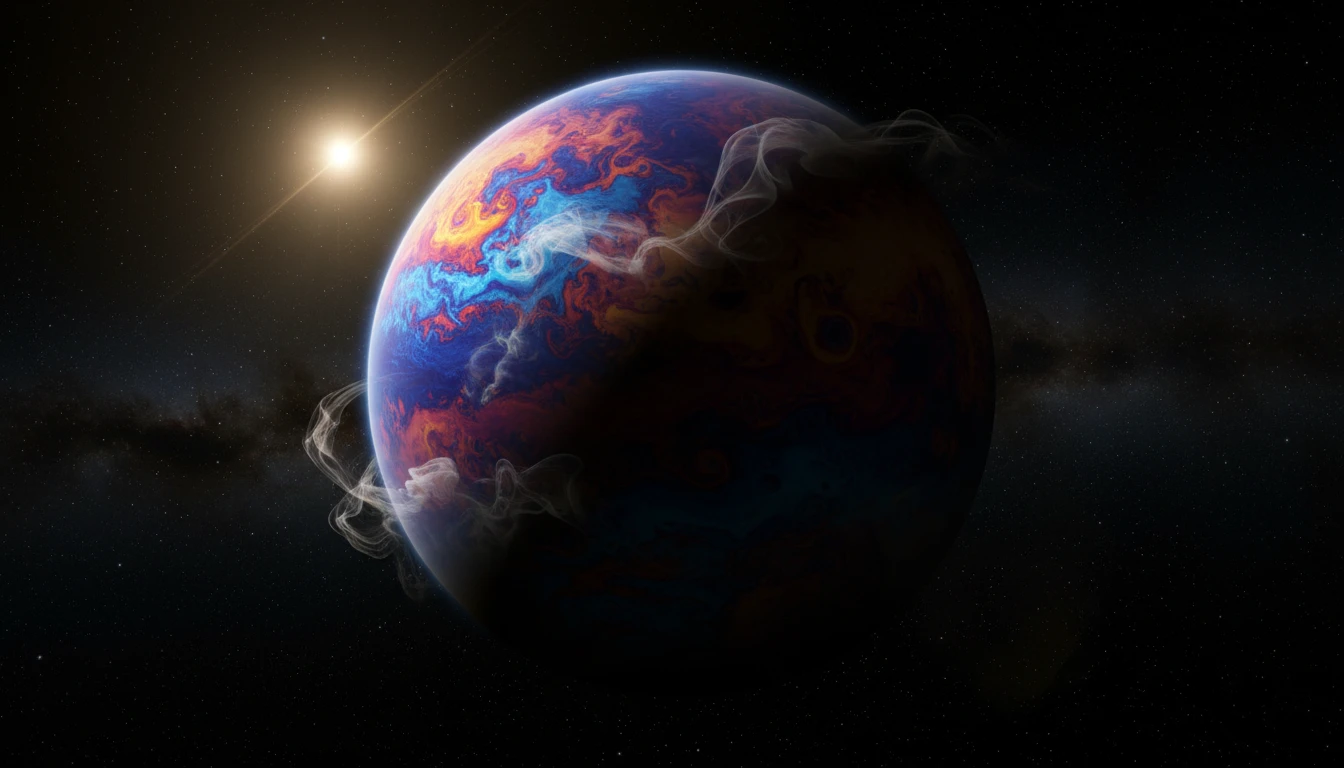
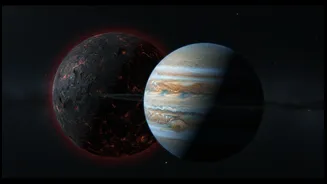
residual heat. By all accounts, any planet orbiting nearby should be vaporized or destroyed. Yet, about 80 light-years away, astronomers have found a Jupiter-sized planet named WD 1856 b doing the impossible. It whips around its white dwarf host every 34 hours, in an orbit so tight it defies all previous models of how planetary systems die. This discovery has turned a cosmic graveyard into a site of intense scientific investigation.
An Impossible Survivor
The sheer strangeness of the WD 1856 b system is hard to overstate. The planet is enormous, estimated to be between four and eleven times the mass of Jupiter. In a bizarre reversal of cosmic norms, the planet is about seven times larger in size than the tiny, dead star it orbits. When this world passes in front of its star, it blocks more than half of the star's light. If the planet had always been this close, it would have been annihilated billions of years ago when its star swelled into a red giant. This fact presented a baffling puzzle for astronomers: how did this giant world end up in such a perilous position yet survive unscathed?
Unraveling the Mystery with Webb
To solve the riddle, scientists turned to the James Webb Space Telescope (JWST). By analyzing the light filtering through the planet's atmosphere, they made two key discoveries. First, they detected the presence of molecules like methane, the first time an atmosphere has been observed on a planet orbiting a dead star. Second, they found the planet was unexpectedly warm, registering about 127 degrees Celsius (260 degrees Fahrenheit). This heat was not coming from the faint white dwarf alone. It was a clue, a residual warmth left over from a dramatic event in the planet's past.
A Tale of Cosmic Migration
The data from the JWST allowed researchers to reconstruct the planet's history. They concluded that WD 1856 b did not survive in its current orbit; it moved there. The most likely scenario is that the planet originally had a wide, safe orbit, far from its star. For billions of years after the star’s death, it remained in this distant path. Then, gravitational nudges—likely from two other companion stars in the same system—pushed the planet on a new trajectory, causing it to migrate inward toward the white dwarf. As it drew closer, the immense gravity of the dense stellar remnant would have caused the planet to heat up considerably, explaining its current warm temperature as it has been cooling ever since.
A Glimpse into Our Own Future
The survival of WD 1856 b offers a fascinating preview of our own solar system's distant future. When our Sun dies in about five billion years, it is expected to destroy the inner planets. The fate of the outer gas giants like Jupiter and Saturn, however, has been an open question. This discovery provides the first direct evidence that large planets can survive their star’s death and even find a new, stable existence around the stellar remnant. It suggests that stellar death is not the final chapter for planetary systems, but perhaps the beginning of a new one, widening the possibilities for where and when life might exist in the universe.