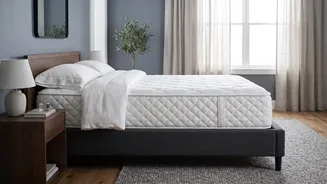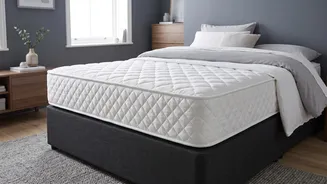







Mattress shopping can be a confusing ordeal, filled with grand claims of 'unparalleled comfort' and 'advanced technology'. But to find a truly supportive spring mattress, you need to look beyond the marketing and understand what's inside.
The Coils: Your Mattress Core
The heart of
any spring mattress is its coil system, which provides the primary support. There are several main types, and each offers a different feel. Bonnell coils are the oldest and most common type, shaped like an hourglass and wired together, creating a firm, bouncy feel. While affordable, this interconnected structure means motion on one side of the bed is easily transferred to the other. Offset coils are similar but have a squared top, allowing them to contour slightly better. Continuous coils use a single long wire for each row, offering durability and a firm surface. The most advanced option is the pocketed coil, where each spring is individually wrapped in a fabric pocket. This allows each coil to move independently, providing superior motion isolation—ideal for couples—and more targeted support for your body's curves.
Coil Count & Gauge: Quality Over Quantity
You'll often see 'coil count' advertised as a key metric, with the assumption that more is always better. While a higher count can provide more points of contact for better contouring, the quality of the coils is far more important. A mattress with 800 well-made coils will almost always outperform one with 1,500 flimsy ones. This is where 'coil gauge' comes in. Gauge refers to the thickness of the wire, and the scale is inverse: a lower number means a thicker, firmer, and more durable wire. A 12-gauge coil is very firm, while a 15-gauge coil is thinner and offers a softer feel. A well-engineered mattress will balance coil count and gauge to provide both support and durability, and some even use different gauges in different zones for targeted support.
Comfort Layers: Beyond the Springs
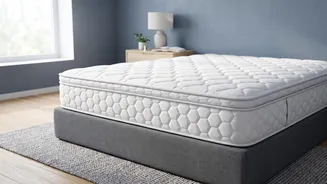
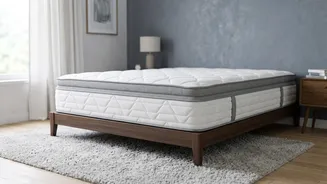
The feel of a mattress isn't just about the springs. The comfort layers—the materials stacked on top of the coil unit—play a huge role in cushioning and pressure relief. These layers can be made from various materials like polyurethane foam, memory foam, or latex. High-density foams and natural fibers can enhance pressure relief while the springs handle the deep support. A 'pillow top' or 'Euro top' refers to extra layers of padding sewn onto the top of the mattress for a plusher surface feel. However, be aware that marketing terms like 'cooling gel' may offer an initial cool-to-the-touch sensation in the showroom but can be less effective once covered by a mattress protector and sheets. The breathability of the entire system, from the open coil structure to the top layers, is what truly determines temperature regulation.
Edge Support: Maximising Your Space
Often overlooked, edge support is a crucial feature for both durability and functionality. It refers to the reinforcement along the perimeter of the mattress, designed to keep the sides from collapsing when you sit on the edge or sleep near it. Good edge support is typically achieved with a border of stronger, lower_gauge coils or a high_density foam encasement. Strong edges increase the usable sleeping surface, which is especially important for couples sharing a bed. It also makes getting in and out of bed easier and helps the mattress maintain its shape over time, preventing premature sagging along the perimeter. If you find yourself sleeping right to the edge, or often sit on the side of your bed, this is a feature you should not ignore.