





What is Self-Healing Concrete?
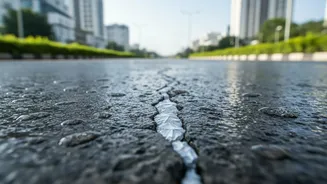
Imagine a road that can fix itself. That’s the core idea behind self-healing concrete, also known as bio-concrete. It’s a special type of concrete that has been engineered to repair its own cracks without human intervention. The technology works by embedding
dormant, harmless bacteria, like Bacillus subtilis, along with a food source (often calcium lactate) into the concrete mix. These microbes are encased in tiny capsules and can lie inactive for years. The moment a crack forms and water seeps in—a constant reality during Indian monsoons—the bacteria awaken. This contact with water triggers a metabolic process where the bacteria consume their food source and produce limestone (calcium carbonate), which then hardens to seal the crack. Think of it as a biological defence mechanism for our infrastructure, quietly working to prevent small cracks from turning into major, vehicle-damaging potholes.
The Monsoon Challenge
India's diverse and often harsh climatic conditions, from extreme heat to high humidity and intense monsoons, take a heavy toll on our roads. The relentless cycle of water seeping into small fissures, which then expand under traffic load, is the primary reason potholes multiply during the rainy season. Traditional repair methods often involve waiting for a dry spell, using hot-mix asphalt that requires heavy machinery, and can be time-consuming. This is where bio-concrete’s unique properties become particularly relevant for India. The very thing that damages conventional roads—water—is the trigger for the healing process in bio-concrete. This makes it an especially promising solution for a country where infrastructure faces an annual battle against the elements, potentially reducing maintenance costs and improving road longevity.
From Lab to Pavement
The concept of self-healing materials is not new, with initial ideas originating in the Netherlands over a decade ago. In India, the technology is moving from theory to practice, driven by research at institutions like IIT Madras and interest from bodies such as the National Highways Authority of India (NHAI). Research has demonstrated significant benefits, with studies showing that bacterial concrete can increase tensile strength and effectively seal cracks up to 1 mm wide. While large-scale urban road deployment is still in its early stages, the NHAI has confirmed it is exploring these innovative materials for future highway construction. The focus is on finding an economical and scalable approach, with some researchers noting that a concrete development plan could emerge within the next couple of years. This shift from lab-based experiments to real-world interest marks a critical step towards more resilient infrastructure.
Hurdles on the Road Ahead
Despite its revolutionary potential, bio-concrete faces several challenges before it becomes a common sight on Indian roads. The primary obstacle is cost. The initial production expense, involving specialized bacterial cultures and nutrients, is significantly higher than for traditional concrete. This makes it a difficult choice for price-sensitive projects, especially in developing regions. There are also questions about the long-term viability of the bacteria—can they survive for decades inside the harsh, alkaline environment of concrete? Furthermore, scaling up production from specialised labs to industrial-level manufacturing requires significant investment and the development of industry standards for quality and performance. While the long-term savings on maintenance could be substantial, overcoming these initial economic and logistical hurdles is key to widespread adoption.