
A World of Extreme Seasons
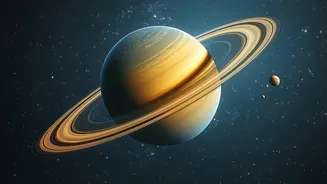
Just like Earth, Saturn experiences seasons, but on a much grander scale. A single season on the gas giant lasts for more than seven Earth years, and its entire journey around the sun takes nearly 30. This long, slow cycle of change creates dramatic shifts
in temperature and sunlight across the planet. For almost 15 years at a time, one of Saturn's poles is plunged into the darkness of winter, while the other enjoys continuous summer sunlight. This extreme seasonal variation is the engine behind many of the atmospheric changes scientists are now observing in greater detail than ever before, thanks to long-term monitoring programs that track the planet's evolution.
The Shadow of the Rings
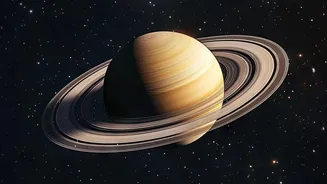
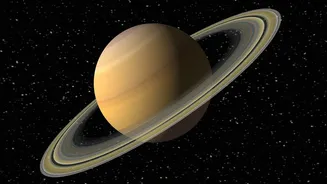
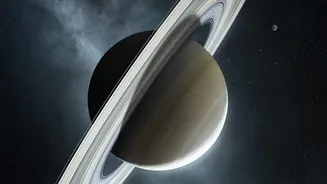
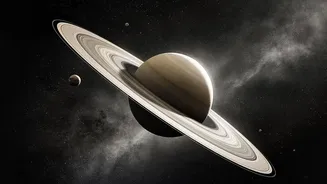
What makes Saturn's seasons even more complex and fascinating is the immense shadow cast by its iconic rings. These vast planes of ice and rock act like a colossal set of blinds, blocking sunlight from reaching certain parts of the planet's atmosphere. The position and size of this shadow change as Saturn moves along its orbit. These shadowed regions become significantly cooler, creating huge temperature differences between the sunlit and shaded zones. Early observations from the Cassini mission showed how this temperature imbalance can drive powerful storms and dynamic weather systems, particularly as areas emerge from the cold shadow into the light of spring.
Seeing the Unseen with Infrared
To understand what happens within these cold, dark regions, visible light isn't enough. That's where the power of infrared imaging comes in. Telescopes like Hubble and the James Webb Space Telescope (JWST) can detect infrared light, which is essentially heat radiation. This allows scientists to see through the upper atmospheric haze and map temperature variations at different depths. While Hubble provides stunning views in visible light, revealing colour variations and cloud bands, infrared observations uncover a hidden layer of information about chemical compositions and deeper atmospheric structures. By combining data from different wavelengths, researchers can effectively slice through Saturn's atmosphere like an onion, building a complete three-dimensional picture of how it works.
What Hubble's Eye Revealed
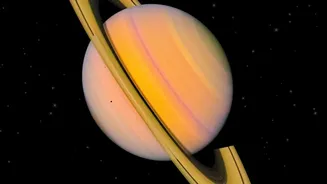
Recent observations from Hubble, particularly from its Outer Planet Atmospheres Legacy (OPAL) program, are providing a continuous record of these atmospheric changes. Coordinated observations with the JWST have further enhanced this view. While the headline focuses on Hubble, its synergy with JWST is key to the latest discoveries. Data captured in 2024 shows the planet as it moves towards its 2025 equinox, a time of rapid seasonal transition. Scientists have been struck by how quickly the atmosphere responds to changes in sunlight when emerging from the ring shadows. These infrared views have highlighted persistent features from past storms, like the remnant of the 'Great Springtime Storm' of 2010-2012, and revealed how powerful winds and waves beneath the visible clouds shape the entire system.
More Than Just Shadows
The ring shadows do more than just cool the atmosphere; they also fundamentally alter its chemistry. The rings block ultraviolet sunlight, which would normally create a charged layer in the upper atmosphere called the ionosphere. Research using data from the Cassini probe found that the ionosphere is significantly weaker in these shaded regions. Furthermore, scientists theorise a phenomenon called “ring rain,” where charged water particles from the rings are pulled into Saturn's atmosphere. This 'rain' can neutralize parts of the ionosphere, creating vast dark bands in what would otherwise be a uniform infrared glow and further complicating the atmospheric dynamics.