



A Sweet Discovery Near the Galaxy's Heart
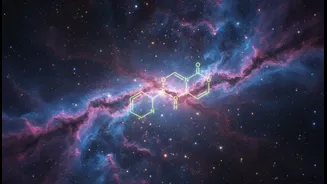
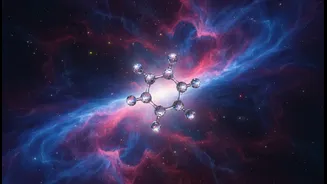
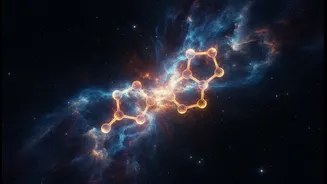
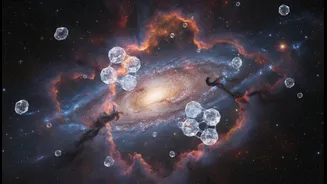
In a significant finding, an international team of astronomers has detected a sugar molecule for the first time in interstellar space. Using powerful radio telescopes in Spain, scientists identified erythrulose, a four-carbon sugar, within a giant, dense
cloud of gas and dust near the centre of our Milky Way galaxy. This molecular cloud, named G+0.693-0.027, is located approximately 27,000 light-years from Earth. While this isn't the kind of sugar you'd stir into a drink—on Earth, it's found in red raspberries and is even used in some sunless tanning products—its presence in such a harsh environment is a landmark discovery. Previously, sugars like ribose and glucose had been found in meteorites, suggesting they could come from space, but this is the first direct detection of a true sugar molecule in the interstellar medium itself.
How Do You Find Sugar in Space?
Detecting a specific molecule thousands of light-years away is a complex process. Scientists used the Yebes 40-meter and IRAM 30-meter radio telescopes to listen for faint radio signals coming from the molecular cloud. Every molecule, when it rotates and vibrates, emits energy at very specific frequencies, creating a unique spectral 'fingerprint'. The team scanned the cloud and picked up 12 distinct signals that perfectly matched the known spectral signature of erythrulose, which had been previously measured in a laboratory. This confirmed its presence in the gas and dust that will one day form new stars and planets. The finding was unexpected because the sugar was found to be surprisingly abundant, challenging previous theories about how large molecules form in space.
A Key Ingredient for Life's Recipe
So, why is finding a simple sugar in deep space so exciting? Sugars are essential biomolecules that play a central role in life as we know it. They form the structural backbone of RNA and DNA, the molecules that carry genetic instructions for all living organisms. The discovery of erythrulose is particularly important because, in the presence of water, it can change into threose, a sugar believed to be an evolutionary predecessor to RNA. This provides a crucial clue to a long-standing puzzle: how did the building blocks of life form on early Earth? Many scientists believe the conditions on our young planet weren't right to produce these molecules in sufficient quantities. This discovery supports the idea that these vital ingredients may have been delivered to Earth from space.
From Stardust to a Cosmic Kitchen
The detection of erythrulose suggests that the chemical processes leading to life might be universal. It shows that complex organic molecules, often called prebiotic molecules, can form in the cold, harsh vacuum of space even before planets exist. These molecules form on the surfaces of icy dust grains, which then get incorporated into comets and asteroids. During the early history of our solar system, a period known as the Late Heavy Bombardment, these comets and asteroids frequently crashed into Earth, potentially delivering millions of tonnes of sugars and other essential compounds. This interstellar 'seeding' could have provided the raw materials necessary to kick-start life. The finding implies that the chemical factory of the cosmos is busy creating life's ingredients across the galaxy, opening up the tantalizing possibility that life could develop elsewhere in the universe.