








The Limits of Sunshine
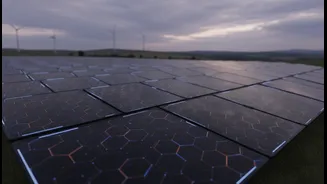
Conventional solar panels, typically made from crystalline silicon, are the backbone of the global solar boom. They have become cheaper and more efficient over time, but they share a fundamental limitation: their power output drops significantly when
the sun isn't shining directly. On a day with light cloud cover, a panel might only generate 70-80% of its peak capacity. During heavy overcast conditions, that can plummet to as low as 10-25%. For a country like India, with its ambitious renewable energy goals and a long, powerful monsoon season, this variability is a major hurdle. It creates an energy bottleneck, limiting solar's reliability and making it harder to depend on as a primary power source year-round.
The Promise of Perovskites
Enter perovskites, a class of materials with a specific crystal structure that has scientists and energy companies buzzing. Unlike silicon, which requires high-temperature, energy-intensive manufacturing, perovskite materials can be processed at lower temperatures, almost like ink printed on a surface. This makes them potentially cheaper and more versatile, opening the door for lightweight and flexible solar cells. Crucially, they are exceptionally good at absorbing diffuse and low-level light. Research has shown perovskite cells can achieve remarkable efficiency indoors under ambient light, far outperforming silicon. This unique property makes them the leading candidate for a new generation of all-weather solar panels.
A Powerful Combination: Tandem Cells
The most exciting frontier in this race isn't about replacing silicon entirely, but enhancing it. Scientists are creating "tandem" solar cells by stacking a thin, semi-transparent layer of perovskite on top of a traditional silicon cell. This creates a powerful duo: the perovskite layer captures high-energy visible and ultraviolet light, while the silicon layer below absorbs the lower-energy infrared light that passes through. By working together to harvest a wider portion of the solar spectrum, this tandem architecture smashes through the theoretical efficiency limits of silicon-only cells. In lab settings, companies like LONGi have already achieved certified efficiencies of nearly 35%, a significant leap from the 20-25% efficiency of most commercial silicon panels.
The Race to Commercial Scale
Despite the record-breaking lab results, perovskite technology still faces hurdles before it can be widely deployed. The biggest challenges are longevity and durability. Early perovskite cells degraded quickly when exposed to moisture and heat—a significant problem for panels expected to last 25 years in the field. However, intense research into new formulations and protective encapsulation techniques is rapidly closing this gap. The race is now a commercial one. Oxford PV, a European company, shipped the first commercial-grade tandem panels in late 2024. With Chinese firms dominating patents and US companies focusing on niche applications, the competition to scale up manufacturing and bring down costs is fierce.
Why It Matters for India
For India, which has seen its solar capacity grow exponentially to over 100 GW, this technology is more than a scientific curiosity. With ambitious targets to install 500 GW of renewable energy by 2030, a significant portion of which is solar, the nation needs resilient and reliable power. All-weather solar cells could be a game-changer, providing more consistent power generation during the four-month monsoon season that blankets much of the country. This would enhance grid stability, reduce reliance on backup fossil fuels, and accelerate the transition to clean energy. As India ramps up its own domestic solar manufacturing, embracing next-generation technologies like tandem cells will be crucial to securing its position as a global solar superpower.