




A Glimpse into Distant Skies
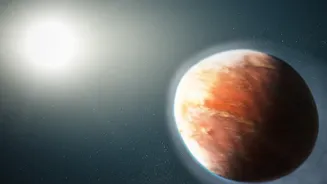
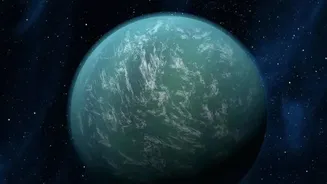
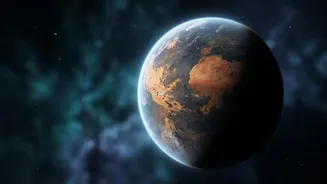
The latest chapter in this cosmic detective story unfolds 120 light-years away, in the constellation Leo. Here orbits an exoplanet named K2-18 b, a world roughly 8.6 times more massive than Earth. This 'super-Earth' has become a prime target for astronomers,
and recent observations by the JWST have confirmed the presence of carbon-bearing molecules like methane and carbon dioxide in its atmosphere. These findings strongly support the theory that K2-18 b could be a 'Hycean' world—a planet with a hydrogen-rich atmosphere and a surface potentially covered by a water ocean. While the Hubble Space Telescope first detected water vapour there in 2019, Webb's powerful new observations are providing a much more detailed picture.
How Webb Reads an Alien Atmosphere
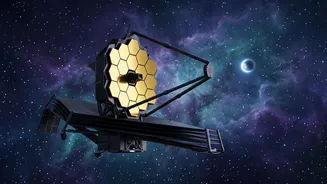
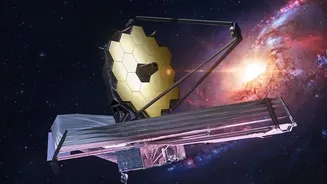
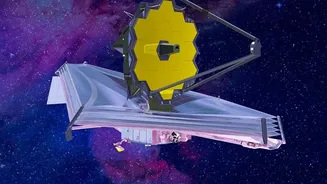
Detecting elements from such an immense distance is a remarkable feat of engineering and science. The technique is called transmission spectroscopy. As an exoplanet like K2-18 b passes in front of its host star from our perspective, a tiny fraction of the starlight filters through the planet's atmosphere. Different gases and molecules absorb specific wavelengths, or colours, of light. The JWST's highly sensitive instruments, particularly its spectrographs, capture this filtered light and spread it out like a rainbow. By identifying which colours are missing, scientists can determine the chemical makeup of the atmosphere, creating a molecular fingerprint of a world hundreds of light-years away.
More Than Just Water Vapour
The data from K2-18 b is fascinating not just for what it shows, but also for what it might be missing. The telescope detected methane and carbon dioxide but a surprising lack of ammonia, which aligns with the possibility of a vast liquid water ocean. Furthermore, the initial data hinted at the possible presence of a molecule called dimethyl sulfide (DMS). On Earth, DMS is overwhelmingly produced by life, particularly phytoplankton in marine environments. However, follow-up analysis has not yet confirmed the DMS signal, and scientists remain cautious. Even without it, the confirmed presence of carbon-based molecules and the potential for a water ocean make K2-18 b an incredibly compelling target for further study.
The Search for Habitable Worlds
It is crucial to understand that finding water vapour, or even a potential ocean, does not automatically mean we have found life. K2-18 b is not 'Earth 2.0'. It orbits a cool dwarf star and may face higher levels of radiation than our planet. The term 'habitable zone' simply refers to the region around a star where temperatures could allow for liquid water to exist on a planet's surface. The presence of water is a key ingredient, but it is only one piece of a very complex puzzle. The significance of these discoveries lies in Webb's demonstrated ability to characterise the atmospheres of these smaller planets, moving beyond the gas giants to study worlds that might have diverse and potentially habitable environments.
What Comes Next for Webb?
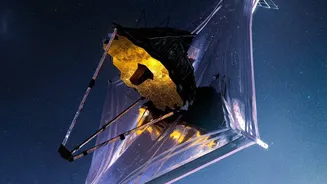
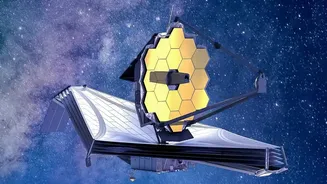
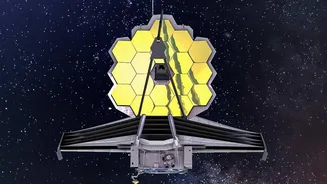
The findings from K2-18 b represent a massive leap forward, transforming exoplanet science from detection to true characterisation. Each observation provides another piece of data that helps scientists refine their models of how planets form and evolve. For K2-18 b, the next step is to conduct more observations to confirm the atmospheric composition and determine if a liquid ocean truly exists on its surface. The James Webb Space Telescope will continue to point its golden mirror at other promising worlds, from hot gas giants like WASP-96 b, where it also found clear signs of water, to rocky planets orbiting nearby stars. Each spectrum it gathers brings us closer to answering that age-old question of whether Earth is unique in the cosmos.