






Meet the ‘Hycean’ World
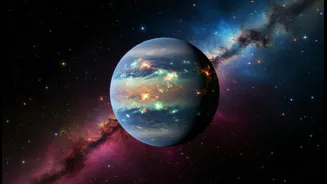
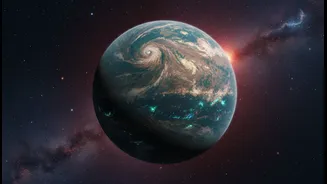
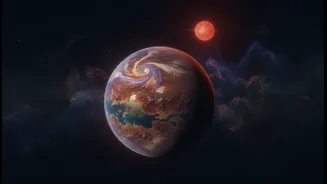
Located about 124 light-years away in the constellation of Leo, K2-18b is not your typical rocky planet. It's what scientists have dubbed a 'Hycean' world, a portmanteau of 'hydrogen' and 'ocean'. This theoretical class of planet is thought to have a vast
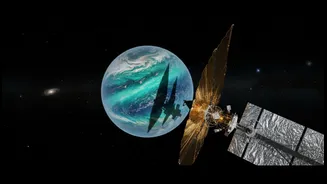
liquid water ocean underneath a dense, hydrogen-rich atmosphere. At about 8.6 times the mass of Earth, it’s a sub-Neptune—a type of planet we don't have in our own solar system but which appears to be common throughout the galaxy. Its position in its star's habitable zone means temperatures could allow for liquid water, a key ingredient for life as we know it. These factors made K2-18b a prime target for the powerful gaze of the James Webb Space Telescope (JWST).
A Whiff of Something Interesting
The excitement peaked when analysis of K2-18b's atmosphere, observed by the JWST as the planet passed in front of its star, revealed the presence of carbon-bearing molecules like methane and carbon dioxide. This was significant, but the truly tantalizing clue was the potential detection of a molecule called dimethyl sulfide (DMS). On Earth, DMS is produced almost exclusively by life, particularly marine microorganisms like phytoplankton. Finding this gas in the atmosphere of a potential ocean world was, for many, the strongest hint yet of biological activity beyond our solar system.
Science, Not Science Fiction
Before we imagine alien microbes, it’s crucial to understand the scientific process, which is built on caution and verification. The detection of DMS is still tentative, not confirmed. The signal reported by one team of researchers has not yet met the 'five-sigma' level of confidence that scientists require to declare a discovery. A signal at a lower confidence level means there's a higher statistical chance it could be a fluke or a misinterpretation of the data. Furthermore, other independent analyses of the same data have found insufficient evidence to confirm the presence of DMS, highlighting the profound challenges of interpreting these faint signals from across the cosmos. Scientists stress that even if DMS is confirmed, unknown non-biological or geological processes on such a different world could potentially produce it.
Expanding the Search for Life
Regardless of the outcome, K2-18b has already changed the game. The very concept of Hycean worlds, proposed in 2021, broadens our ideas of where life could thrive. For a long time, the search focused on finding Earth-like rocky planets. Hycean worlds suggest that larger planets with different atmospheres could also host vast, life-sustaining oceans. The data from K2-18b, confirming a carbon-rich atmosphere on a planet that could have a water ocean, provides the first real-world evidence supporting this exciting new theory. It shows that we have the technology to not just find exoplanets, but to begin sniffing their atmospheres for clues.
What Happens Next?
The story of K2-18b is far from over. The team that reported the DMS signal is pushing for more observation time with the JWST to strengthen their data. Their goal is to either confirm the signal with higher confidence or rule it out. Other teams will continue to scrutinize the existing data and develop models for how K2-18b's atmosphere might work, both with and without life. This is not a single 'eureka' moment but a meticulous investigation unfolding light-years away. Future observatories, like the planned Habitable Worlds Observatory, will be designed specifically to answer these questions with even greater clarity. For now, K2-18b remains a fascinating puzzle box, and every new piece of information marks a significant step forward in one of humanity's greatest quests.