

A Tiny Target in a Distant System
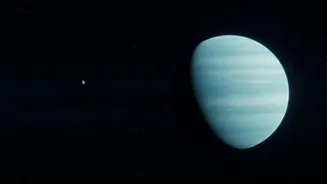
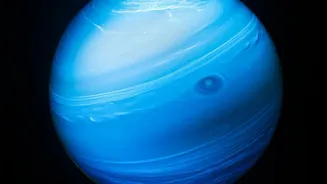
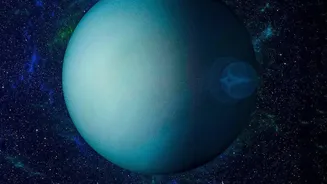
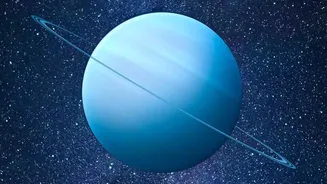
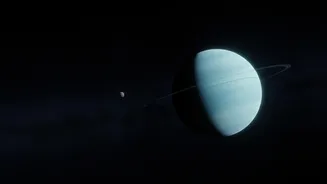
The new moon, provisionally named S/2023 U1, is a cosmic speck. At only about eight kilometres in diameter, it's likely the smallest of Uranus's 28 known moons. It was first spotted on November 4, 2023, by astronomer Scott Sheppard of the Carnegie Institution
for Science, using the powerful Magellan telescopes in Chile. The discovery was a triumph of modern astronomy; Sheppard and his team had to use special image-processing techniques to reveal such a faint object. Confirming its existence wasn't easy. After the initial sighting, Sheppard worked with scientists from NASA's Jet Propulsion Laboratory to predict its orbit, which allowed them to find the moon in older images taken as far back as 2021, solidifying its status as a new member of the Uranian family. In keeping with tradition for the planet's satellites, it will eventually be named after a character from a Shakespeare play.
A Peculiar Path
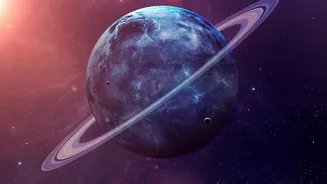
What truly makes S/2023 U1 interesting to astronomers is its movement. The moon has a long and unusual journey around its parent planet, taking 680 Earth days to complete a single orbit. Its path is highly eccentric and inclined, meaning it's not a neat circle around the planet's equator. These characteristics place it firmly in the category of an "irregular moon." Unlike the larger, more orderly moons like Titania and Oberon, which likely formed from a disk of gas and dust that once surrounded Uranus, irregular moons are thought to be captured objects. They were likely comets or asteroids that strayed too close to the ice giant in the distant past and were ensnared by its powerful gravity. This makes them less like children of the planet and more like adopted drifters from the wider solar system.
A Window Into a Chaotic Past
Studying the orbit of S/2023 U1 gives scientists a valuable data point for understanding the history of our solar system. The orbits of these irregular moons are clues about a turbulent era billions of years ago when the giant planets were migrating, flinging smaller objects around like a cosmic game of pinball. By tracing the paths of captured moons like this one, researchers can refine their models of how and when the giant planets settled into their current positions. Furthermore, the new moon's orbit is similar to two other Uranian moons, Caliban and Stephano. This suggests they might all be fragments of a single, larger body that was captured by Uranus and then shattered by a collision long ago. Finding these orbital groupings helps astronomers piece together the violent events that shaped the planetary systems we see today.
How Astronomers Found a Ghost
Discovering S/2023 U1 was a technical marvel. Finding an eight-kilometre object from over 2.5 billion kilometres away is like trying to spot a specific piece of gravel in another city using a telescope. Astronomers achieved this by taking many long-exposure images over several hours. They then used a 'shift-and-add' technique, digitally stacking the images and shifting them to match the predicted movement of Uranus across the sky. This process makes faint objects moving with the planet, like a tiny moon, appear as points of light, while the more distant background stars and galaxies are smeared into trails. The breakthrough highlights the power of modern ground-based observatories and sophisticated image processing, which allow astronomers to push the boundaries of what is detectable. It was the first new moon found around Uranus in more than 20 years, a testament to the persistence and advanced tools required for such a find.