

A Tempest for the Ages
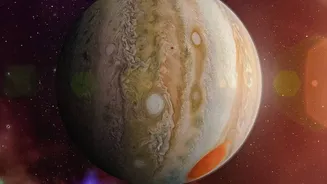
For as long as humans have pointed powerful telescopes at Jupiter, the Great Red Spot has been its most defining feature. It is a colossal anticyclone, a high-pressure system spinning counter-clockwise in the gas giant's southern hemisphere with winds
far more powerful than any hurricane on Earth. To put its scale into perspective, when astronomers first began detailed observations in the late 1800s, the storm was vast enough to swallow three Earths with room to spare. First formally monitored in 1830 and possibly sighted as far back as the 1600s, this storm has been a near-constant in our view of the outer solar system, a symbol of permanence and power.
The Incredible Shrinking Storm
That permanence is now in question. For decades, scientists have known the Great Red Spot is diminishing. When NASA's Voyager probes flew by in 1979, the storm had shrunk to about 23,000 kilometres across. By 1995, Hubble Space Telescope images showed it was down to around 21,000 kilometres. Recent measurements from Hubble now put its diameter at just over 16,000 kilometres — still wider than our own planet, but a shadow of its former self. The rate of shrinkage has apparently accelerated since 2012, losing hundreds of kilometres of its waistline each year. This long-term downsizing has astronomers wondering about the storm's future.
From Oval to Circle
It’s not just getting smaller; its shape is transforming. Historically, the feature was a distinct oval, sometimes described as a cigar shape. However, as it has contracted, it has become noticeably more circular. This change in geometry is significant because it signals a fundamental shift in the storm's internal dynamics. Some scientists suggest that as the storm shrinks horizontally, it may be stretching vertically, becoming taller. It's like a potter shaping clay: pushing in on the sides makes the vessel grow upwards. This reshaping, combined with the shrinkage, provides crucial clues about the forces powering the vortex.
What the New Pictures Reveal
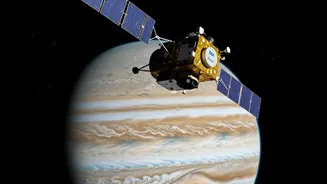
The latest, highly detailed images from the Hubble Space Telescope and NASA's Juno spacecraft, which has been orbiting Jupiter since 2016, are providing unprecedented insight. These new captures show not just the storm's smaller size but also greater detail within its turbulent clouds. Scientists have observed that the winds on the storm's outer edges are actually speeding up, even as the storm itself contracts. There is also evidence of smaller storms, or eddies, being drawn into the Great Red Spot. This has led to a leading hypothesis that these smaller storms might be altering the larger storm’s energy and momentum, effectively chipping away at it or changing its internal structure.
The Mystery of Its Future
So, will the Great Red Spot disappear entirely? The answer is uncertain. Some models predict it could become fully circular by 2040, but what happens after that is anyone's guess. The reasons for its longevity are themselves a topic of debate; one theory suggests it is trapped between two powerful jet streams that keep it spinning. The lack of a solid surface on the gas giant means there is no friction to slow it down, unlike storms on Earth. However, the current changes suggest its energy balance is shifting. Scientists are now working to determine if the smaller eddies feeding the storm are providing fuel or sapping its strength. The storm's deep red colour, the cause of which is still not fully understood, has also been observed to be intensifying in recent years, adding another layer to the puzzle.