








What is the Summer Solstice?
At its simplest, the summer solstice is the moment when the Sun reaches its highest and northernmost point in the sky. For us in the Northern Hemisphere, this marks the official start of astronomical summer. It's the day with the most daylight hours in the entire
year. The word 'solstice' itself comes from the Latin 'sol' (sun) and 'stitium' (to stand still). This is because, for a few days around the solstice, the Sun's apparent path across the sky seems to pause before it begins its slow journey southward again.
It’s All About the Tilt
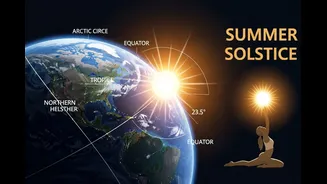
The common misconception is that summer happens because the Earth is closer to the Sun. In reality, our seasons are almost entirely dictated by our planet's axial tilt. Earth is tilted on its axis by approximately 23.5 degrees. As we orbit the Sun, this tilt means that for half the year, the Northern Hemisphere is angled more directly towards the Sun, and for the other half, the Southern Hemisphere gets more direct sunlight. On the June solstice, the North Pole is tilted most directly towards the Sun, bathing our hemisphere in the maximum amount of light and heat. Conversely, the Southern Hemisphere is tilted away, experiencing its winter solstice and the shortest day of the year.
The 'Geometric Shift' Explained
Here’s where it gets interesting. You might assume that we gain a few minutes of daylight every day until the solstice, and then immediately start losing them at the same rate. But that's not how it works. The change in daylight hours follows a geometric curve, not a straight line. Think of a pendulum swinging: it moves fastest at the bottom of its arc and slows to a near-standstill at its highest point. The change in daylight hours behaves similarly. The fastest changes happen around the equinoxes in March and September. As we approach the solstice in June, the rate of change slows dramatically. We might only gain a few seconds of daylight each day in the week leading up to June 21. This 'pause' is the geometric shift—a beautiful, predictable rhythm dictated by the geometry of our planet's orbit and tilt.
How India Experiences the Solstice
The effect of the solstice isn't uniform across the globe, or even across India. Your latitude—how far north or south you are from the equator—plays a huge role. Cities at higher latitudes experience more extreme differences in day length. For example, on the solstice, a city like Leh in Ladakh will have a significantly longer day (over 14 hours of daylight) than Kanyakumari at the southern tip of India, which is much closer to the equator and experiences a more consistent 12-hour day/night cycle year-round. Delhi and Mumbai will fall somewhere in between, enjoying around 13.5-14 hours of sunlight. This is a direct consequence of the Sun's higher path across the sky in the north.
Not Always the Hottest Day
While the solstice brings the most sunlight, it's rarely the hottest day of the year. This is due to a phenomenon called 'seasonal lag'. Our planet's oceans and landmasses take time to heat up. They absorb the immense solar energy from the long summer days and gradually release it, causing peak summer temperatures to typically occur a few weeks or even a month later, in July or August. So, while June 21 marks the peak of solar radiation, the peak of the heat is still to come for most of us in India.