







The Urban Heat Challenge
India's rapidly growing urban centres are facing a significant challenge: the urban heat island effect. Concrete, asphalt, and dense construction absorb and retain far more heat than natural landscapes, making city temperatures several degrees warmer.
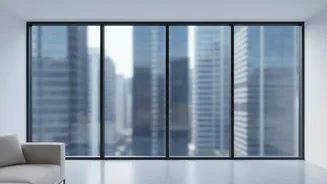
This reality, combined with increasingly frequent and intense heatwaves, places an enormous strain on both households and the national power grid. For millions of families, air conditioning is no longer a luxury but a necessity, leading to soaring electricity consumption and monthly bills. Buildings are a major contributor to this energy demand, and windows are often the weakest link, allowing solar heat to pour into homes and offices. This has spurred a critical search for smarter, more sustainable building materials that can keep interiors cool without consuming massive amounts of power.
Introducing Thermo-Responsive Glass
Imagine a window coating so thin it's practically invisible, yet smart enough to adapt to the weather. This is the promise of thermo-responsive, or thermochromic, glass coatings. Unlike standard tinted windows or blinds, which block light all the time, these advanced materials automatically change their properties based on temperature. When it's cool outside, the coating remains transparent, allowing natural light and warmth to pass through. But when the temperature on the glass rises above a certain point, the coating activates, transforming to block the sun's heat-carrying infrared radiation. This dynamic response means you get the best of both worlds: warmth in the winter and cooling in the summer, all without flipping a switch.
How It Works: The Science of Cool
The magic behind most of these coatings lies in a compound called vanadium dioxide (VO2). This material has a fascinating property: it undergoes a reversible phase transition at a specific temperature. Below about 67°C, vanadium dioxide acts as a semiconductor, letting most light and heat pass through. But once it heats up past that threshold, its crystal structure rearranges, and it behaves more like a metal, reflecting infrared light while still allowing visible light to enter. Researchers are working to lower this transition temperature to make it more practical for everyday use. The coating itself is incredibly thin—often thousands of times thinner than a human hair—and can be applied to existing glass, turning a 'dumb' window into a 'smart' one without needing complex electronics or wiring.
The Promise of Significant Savings
The potential impact of this technology is enormous. By automatically preventing solar heat gain during the hottest parts of the day, thermo-responsive coatings can dramatically reduce the need for air conditioning. Studies and lab tests have shown that buildings using this type of smart glass could see annual energy savings of 20% or more compared to standard double-glazed windows. For an average Indian household, this could translate into a noticeable reduction in electricity bills during the punishing summer months. Beyond cost savings, the technology promises greater indoor comfort and a reduced carbon footprint for buildings, aligning with India's national goals for energy efficiency and emissions reduction.
Hurdles on the Horizon
While the technology is incredibly promising, several challenges must be overcome before it becomes a common feature in Indian homes. A key obstacle has been the high transition temperature of vanadium dioxide, although scientists are making progress in lowering it. Other considerations include the material's durability over a long lifespan, especially in harsh weather conditions involving dust and heavy monsoons. Cost and large-scale manufacturing are also significant factors. Like many new technologies, the initial price may be higher than conventional solutions, which could slow down adoption. However, researchers are developing more cost-effective application methods that could make it commercially viable sooner.