


Why Venus? Earth's 'Evil Twin'
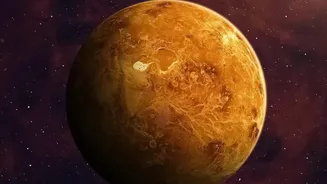
Venus is often called Earth's twin due to its similar size, mass, and density. However, the similarities end there. Venus is the most hostile planet in our solar system, with a crushing atmospheric pressure over 90 times that of Earth's and surface temperatures
around 465°C, hot enough to melt lead. Its thick, toxic atmosphere is primarily carbon dioxide, with dense clouds of corrosive sulfuric acid that completely hide its surface from view. Scientists believe that understanding why Venus turned into this inferno, while Earth became a haven for life, could hold crucial lessons about planetary evolution and climate change. Shukrayaan aims to investigate this very question.
The Mission's Ambitious Goals
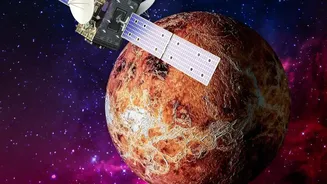
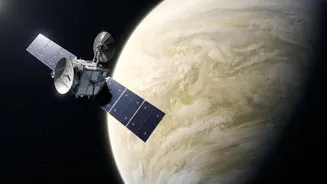
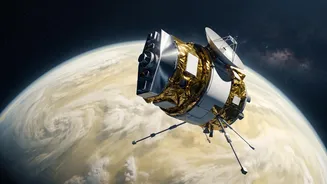
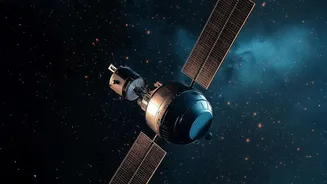
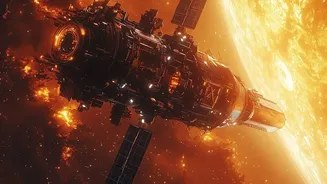
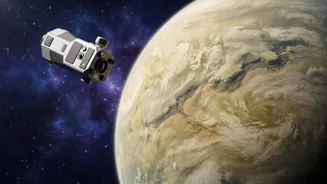
Formally approved by the government in September 2024, the Shukrayaan orbiter mission is a major step for India's interplanetary program. Scheduled for a potential launch on March 29, 2028, aboard the powerful LVM-3 rocket, the spacecraft will embark on a 112-day journey to enter an elliptical orbit around Venus. The mission's primary goals are to conduct a detailed investigation of the Venusian surface and subsurface, analyse the complex chemistry of its atmosphere, and study the interaction between the planet and the solar wind, the stream of charged particles flowing from the Sun.
Peering Beneath the Veil of Acid
The key challenge in studying Venus is its impenetrable cloud cover. To overcome this, Shukrayaan’s flagship instrument will be a high-resolution Synthetic Aperture Radar (SAR). This powerful radar can peer through the thick atmosphere, day or night, to map the planet's surface with a resolution said to be four times greater than NASA's Magellan mission from the 1990s. Even more uniquely, the mission is expected to carry a ground-penetrating radar, making it the first-ever attempt to study the subsurface stratigraphy of Venus. This could reveal buried lava channels, geological structures, and provide clues about the planet's volcanic history.
A Suite of Sophisticated Instruments
The orbiter is planned to carry a suite of around 19 scientific instruments, weighing approximately 100 kg. These include Indian-made payloads and international collaborations with countries like Sweden, Russia, and Germany. Instruments like the Venus Thermal Camera (VTC) and Venus Surface Emissivity and Atmospheric Mapper (VSEAM) will study thermal emissions and search for volcanic hotspots. Others will analyse the composition and dynamics of the atmosphere, look for lightning, and examine how Venus, which lacks a global magnetic field, loses its atmosphere to the solar wind. This comprehensive payload will provide a holistic view of the planet, from its ionosphere down to its hidden surface.
India's Place in a New Space Race
ISRO is not alone in its renewed interest in Venus. NASA is also planning two missions, VERITAS and DAVINCI, while the European Space Agency is developing its EnVision orbiter. This global focus signals a new era of Venus exploration. For India, Shukrayaan is more than just a scientific mission; it's a demonstration of the country's growing technological prowess in designing and executing complex deep-space projects on a cost-effective budget. Following the historic successes of Chandrayaan and Mangalyaan, Shukrayaan is poised to cement India's status as a major player in the exploration of our solar system.