


The Familiar Face of Saturn
For decades, our image of Saturn has been defined by two main features: its stunningly complex ring system and the mysterious, long-lived hexagon at its north pole. This six-sided jet stream, first spotted by the Voyager probes in the 1980s, is a stable
weather pattern wider than Earth, which has fascinated and puzzled scientists. Atmospheric bands, driven by powerful winds reaching speeds of over 1,600 kilometres per hour, are normal for gas giants. But for years, the southern pole appeared relatively calm, lacking a geometric counterpart to the northern hexagon. Observations by NASA's Cassini spacecraft, which orbited the planet from 2004 to 2017, found a large polar vortex but no persistent, polygonal wave.
A New Southern Mystery Emerges
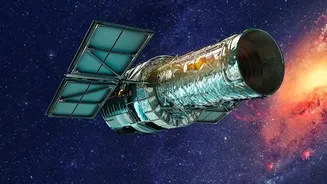
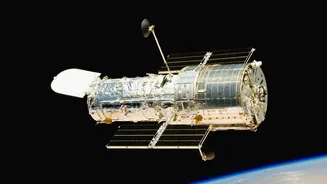
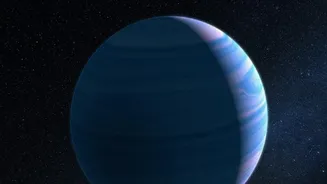
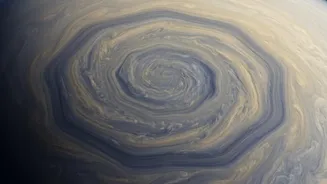
Now, that picture is changing. Thanks to Saturn's long, 29-year seasonal cycle, its south pole has tilted back toward Earth, coming out of shadow for the first time in over a decade. This new vantage point has allowed astronomers, including amateurs, to spot something incredible. Starting around 2024, faint undulations were noticed in the southern hemisphere. Follow-up observations with NASA's Hubble Space Telescope confirmed the presence of a massive, 10-sided wave, or decagon, forming around the south pole. By analysing archival Hubble data, scientists traced the feature's origins back to 2023, watching it strengthen over just a few years. This provided a rare opportunity to witness the birth of a colossal planetary weather pattern.
What Makes the Decagon Different?
While it might seem like a simple southern twin to the northern hexagon, the new decagon is distinct. The northern hexagon has been a stable fixture for over 40 years, a permanent feature of the planet's atmosphere. The southern decagon, however, is a newcomer. Scientists have been searching for a southern polygon since the 1990s with no success until now. Its recent and relatively rapid formation suggests it is a different kind of phenomenon. Unlike a surface-level storm, this wave is a deep, three-dimensional structure. It extends vertically through multiple layers of Saturn's atmosphere, indicating it is a powerful and significant atmospheric event, not just a pattern in the upper cloud tops. This vertical structure helps create its clear ten-sided shape in the powerful jet stream at around 63 degrees south latitude.
Unlocking Secrets of Giant Planets
The discovery of the decagon is more than just a curiosity; it offers vital clues into the complex physics governing the atmospheres of gas giants. One of the biggest questions is why it formed now. Scientists speculate that a large storm or some other significant disturbance deep within the atmosphere could have triggered the change in the jet stream, forcing it into this stable, 10-sided pattern. The fact that it formed so recently and is still evolving gives researchers a live-action look at atmospheric dynamics that were previously only theoretical. Studying how this wave behaves over the coming years—whether it becomes a permanent fixture like the hexagon or dissolves—will help refine models of how planetary atmospheres distribute energy. This knowledge is not just crucial for understanding Saturn, but also for studying the thousands of gas giant exoplanets discovered orbiting other stars.