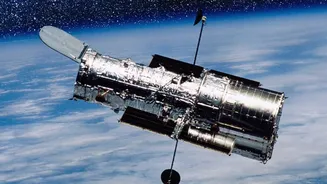





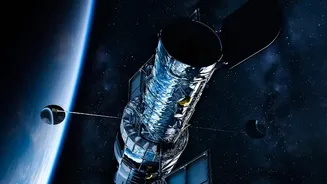
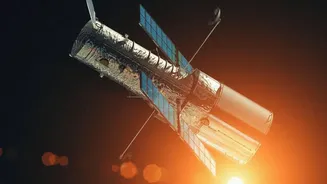
For over three decades, the Hubble Space Telescope has been humanity’s eye into the cosmos. But this legendary observatory is slowly falling. Now, NASA is looking for a hero, not from its own ranks, but from the commercial space industry.
Gravity's Unseen Tug
The Hubble Space
Telescope circles our planet at an altitude where the atmosphere is incredibly thin, but not entirely absent. This faint wisp of air creates a constant, tiny amount of drag on the school-bus-sized observatory. Over years and decades, this gentle but persistent friction causes Hubble to lose speed and, consequently, altitude. This process, known as orbital decay, is an unavoidable reality for all objects in low-Earth orbit. Unlike many modern satellites, Hubble has no onboard propulsion system to fire up and counteract this slow descent. Current projections estimate that without intervention, the telescope could make an uncontrolled re-entry into Earth's atmosphere sometime in the mid-2030s.
A Call for Commercial Heroes
Recognizing the impending deadline, NASA has formally issued a 'Request for Information' (RFI). This is essentially an open call to the burgeoning private space industry, asking for ideas and technical proposals on how to save its prized asset. The request outlines three main possibilities: a mission to boost Hubble into a higher, more stable orbit; a more complex servicing mission to potentially upgrade its systems; or a plan to guide the telescope to a safe, controlled de-orbit over an unpopulated stretch of ocean at the end of its life. By turning to commercial partners, NASA is acknowledging a major shift in the space landscape. The agency is betting that the innovation and cost-effectiveness of private companies could provide a viable solution that the government might not be able to execute on its own.
An Ambitious Precedent
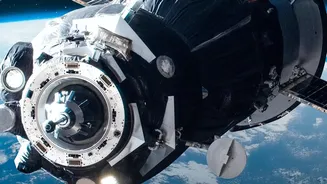
This public request follows a pioneering, unsolicited proposal made in 2022. SpaceX, in partnership with the Polaris Program funded by billionaire Jared Isaacman, approached NASA with the idea of using a Dragon spacecraft to visit and reboost Hubble. The proposal, which would come at no cost to the US taxpayer, would involve a crewed mission to rendezvous with the telescope and gently push it into a higher orbit, potentially adding decades to its operational life. That initial study helped lay the groundwork for this broader RFI, proving that complex servicing missions, once the exclusive domain of government space agencies, are now within the realm of commercial possibility. The Polaris Program, which aims to advance human spaceflight capabilities, sees a Hubble mission as a landmark achievement for the private sector.
A New Era of Space Servicing
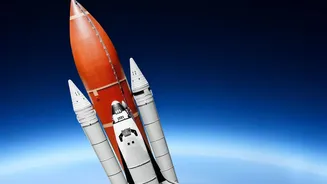
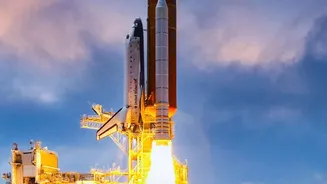
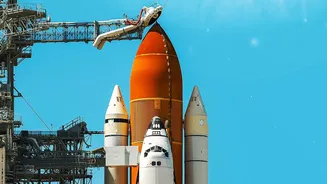
This new approach stands in stark contrast to Hubble's past. The telescope was specifically designed to be serviced in space by astronauts aboard the Space Shuttle. Between 1993 and 2009, NASA conducted five heroic and highly complex shuttle missions to repair and upgrade the observatory. The very first mission famously corrected a flaw in the telescope's primary mirror, turning it from a public embarrassment into one of the most productive scientific instruments ever built. Subsequent missions replaced gyroscopes, installed new cameras, and boosted its orbit. With the Space Shuttle fleet retired in 2011, NASA lost its inhouse ability to physically visit the telescope, making this new commercial opportunity the only path forward.
Why Saving Hubble Matters
Extending Hubble's life is about more than just preserving a piece of history. For over 36 years, the telescope has been a discovery machine, fundamentally changing our understanding of the universe. It has helped determine the age of the cosmos, provided evidence for supermassive black holes, and delivered breathtaking images that have inspired a generation. Its ability to observe in visible and ultraviolet light remains a unique and critical capability that newer observatories like the James Webb Space Telescope do not replicate. Losing Hubble would leave a significant gap in astronomers' ability to study the universe. A successful reboost could keep this iconic observatory delivering groundbreaking science well into the 2040s, serving as a bridge to future flagship missions.