



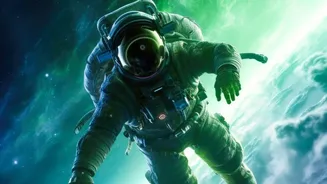

2001: A Space Odyssey (1968)
The benchmark against which all other space films are measured. Stanley Kubrick’s masterpiece was a visual effects revelation decades ahead of its time. Made before the moon landing, it used pioneering practical effects, not digital ones, to create a vision
of space travel that felt utterly convincing. Kubrick famously insisted on creating effects “in camera” to avoid a degraded picture, resulting in a crisp, hyper-realistic look that still holds up. From the elegant, waltzing space stations to the terrifyingly silent void and the mind-bending Stargate sequence, the film is a meditative and monumental piece of art that uses visuals, not just dialogue, to explore humanity’s place in the universe.
Gravity (2013)
Less a story about space and more a survival thriller set within it, Alfonso Cuarón’s film is a masterclass in immersive, terrifying spectacle. The film’s groundbreaking visual effects created a seamless zero-gravity environment, making audiences feel every heart-pounding moment as Dr. Ryan Stone (Sandra Bullock) tumbles through the void. The filmmakers developed entirely new technology to achieve the effect of weightlessness, using complex robotics and massive LED light boxes to create the illusion. The result is a visceral experience that puts you right inside the helmet, transforming the beauty of space into a treacherous and hostile landscape. It’s a film that isn't just watched, but experienced.
Interstellar (2014)
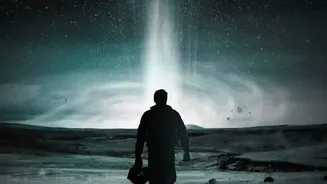
Christopher Nolan’s epic is as much a scientific document as it is a blockbuster. To bring the film’s cosmic phenomena to life, the effects team worked closely with theoretical physicist Kip Thorne to create scientifically accurate visualisations of a wormhole and a black hole. These weren't just artist's impressions; they were based on real scientific equations. The film also blended its stunning CGI with clever practical techniques; instead of just using green screens, the crew projected the visual effects onto massive screens behind the actors, allowing them to react to the cosmic landscapes in real-time. This commitment to realism paid off, earning the film an Academy Award for Best Visual Effects and giving audiences an unforgettable glimpse into the universe's most mysterious corners.
Ad Astra (2019)
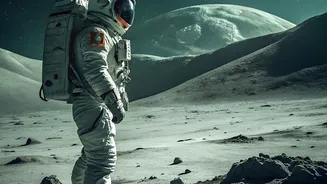
While many space epics focus on the vastness of the cosmos, James Gray’s 'Ad Astra' uses it as a canvas for a deeply intimate and psychological story. The film follows astronaut Roy McBride (Brad Pitt) on a lonely mission across the solar system, and the visuals reflect his internal state. Cinematographer Hoyte van Hoytema, who also shot 'Interstellar', gives the film a stunning, painterly quality. The visuals are grounded in a plausible “retro future” aesthetic, drawing on references from NASA and military technology to create a world that feels functional and real. From a frantic rover chase on the moon to the hauntingly quiet rings of Neptune, the film’s beauty lies in its restraint, proving that spectacle can be quiet and contemplative too.
Dune (2021)
Denis Villeneuve’s adaptation of Frank Herbert’s novel is a masterwork of scale and world-building. Everything in 'Dune' is designed to feel immense, ancient, and overwhelming. The visual effects team went to extraordinary lengths to ground the fantasy, favouring real locations and practical effects whenever possible. For scenes on the desert planet of Arrakis, the crew filmed on location and even used sand-coloured screens instead of traditional green or blue screens to better integrate the digital elements with the natural lighting. The result is a world that feels tangible, from the brutalist architecture of the cities to the terrifying majesty of the giant sandworms. It’s a film that completely immerses you in its alien, yet believable, universe.