
How Webb 'Sees' an Atmosphere
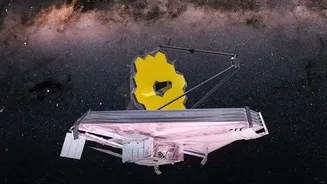
One of the primary techniques astronomers use with JWST is called transit spectroscopy. This method involves watching an exoplanet as it passes in front of its host star from our perspective. As the starlight filters through the edge of the planet's atmosphere,
some of it gets absorbed by the gases present. Different molecules absorb different wavelengths, or colours, of light. By analysing the starlight before, during, and after the transit, scientists can see which colours are missing and create a spectrum that acts like a chemical fingerprint for the atmosphere.
The Infrared Advantage
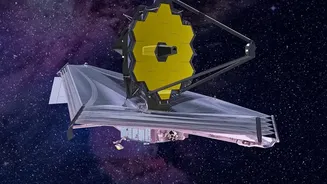
JWST’s incredible power comes from its ability to see the universe in infrared light, which is invisible to the human eye. Many of the most scientifically interesting molecules, like water, methane, and carbon dioxide, have strong absorption features in the infrared part of the spectrum. This makes Webb uniquely suited for this work. Previous telescopes could only hint at these chemicals, but JWST can detect them with remarkable clarity, giving us a detailed list of ingredients for distant worlds.
A Library of Alien Skies
The data from JWST is already building a diverse library of planetary atmospheres. On the hot, Saturn-like planet WASP-39b, the telescope found a rich soup of molecules including the first-ever detection of sulfur dioxide in an exoplanet atmosphere, likely created by the star's intense light. For another world, WASP-96b, Webb provided a clear detection of water vapour in its atmosphere. More recently, observations of the temperate gas giant TOI-199b revealed the presence of methane, and hints of ammonia and carbon dioxide. These findings help astronomers understand the vast diversity of planets in our galaxy, most of which are unlike anything in our own solar system.
Puzzling Weather and Strange Clouds
Beyond just listing chemicals, the infrared data is also revealing dynamic weather on distant worlds. On the gas giant WASP-94A b, for example, astronomers discovered a bizarre daily cycle. The planet appears to have clouds made of rock-like minerals that form in the morning and then completely vaporise by the evening, leaving the skies clear. On another hot gas giant, HD 189733b, temperature measurements indicated the presence of powerful winds circulating heat from the planet's scorching dayside to its cooler nightside. This level of detail about weather on planets hundreds of light-years away was considered impossible just a few years ago.
The Search for Biosignatures
The ultimate goal for many is to find a planet with an atmosphere that shows signs of life. These signs, called biosignatures, are chemicals that are most likely produced by living organisms. One exciting candidate is the exoplanet K2-18b, a world larger than Earth that orbits in its star's habitable zone. JWST has detected methane and carbon dioxide in its atmosphere. While this combination is intriguing, and some studies have hinted at other potential biosignature gases, it is not definitive proof of life. The presence of these gases could have non-biological explanations, and scientists caution that much more data is needed to confirm any such discovery.