



A Journey Measured in Light-Years
When we talk about the vast distances in space, our usual units like kilometres feel tiny and impractical. Instead, astronomers use the 'light-year'. This isn’t a measure of time, but of distance: it’s the distance light travels in one year. And light is incredibly
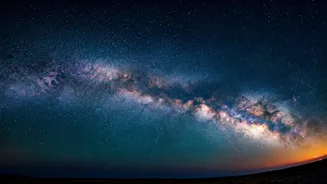
fast, moving at about 300,000 kilometres per second. In a single year, it covers a staggering 9.5 trillion kilometres. So, when we say a star is 1,000 light-years away, it means the light from that star has been travelling for a full millennium to finally reach our eyes. The night sky isn’t a snapshot of the present; it's a deeply layered collage of the past.
Reading the Age of Familiar Stars
Let’s put this into perspective with stars you can actually see from India. Look for Saptarishi (the Big Dipper). The light from most of those seven stars started its journey about 80 years ago, around the time of India’s independence. See that brilliant, twinkling star, Vyadha (Sirius)? Its light is from just under 9 years ago. But then you have Dhruva Tara (Polaris), the North Star. The light you see from it tonight left when the Taj Mahal was being built, around 430 years ago. And what about the magnificent constellation Kalpurush (Orion)? The light from the fuzzy patch in its 'sword', the Orion Nebula, began its journey over 1,300 years ago, when the Pallava and Chalukya dynasties reigned in the south. The headline is true: much of the starlight we see is ancient history.
Are We Seeing Cosmic Ghosts?
This leads to a fascinating and slightly spooky question: if a star’s light takes so long to reach us, could the star already be dead? The answer is yes, it's possible. If a star 1,000 light-years away exploded 500 years ago, we wouldn't know for another 500 years. We would still see it shining brightly in our sky, completely unaware of its demise. However, for the majority of stars we see with the naked eye, this is highly unlikely. Most nearby stars are stable and have lifespans of billions of years. While the 'cosmic ghost' idea is a powerful one, the stars you see tonight are almost certainly still there. The real magic isn't that they might be gone, but that we are seeing them as they were in a distant past.
Going Deeper: A Million-Year Gaze
The story gets even more profound when we look beyond individual stars. On a very clear, dark night, far from city lights, you might be able to spot a faint, fuzzy smudge in the sky. This is the Andromeda Galaxy, our closest major galactic neighbour. It is not a star, but a collection of a trillion stars. The light from Andromeda that reaches your eyes tonight started its journey 2.5 million years ago. At that time, our earliest human ancestors were just beginning to walk the plains of Africa. Every time you catch a glimpse of Andromeda, you are looking millions of years into the past with your own two eyes.
Your Personal Window to the Past
What this ultimately means is that the night sky is the most magnificent museum you will ever visit. It’s a place where you can see light from the time of ancient kings, medieval empires, and the dawn of humanity, all at once. Each pinpoint of light is a historical artefact. It’s a humbling reminder of the scale of the universe and our small, precious place within it. The starlight isn't just hitting your eyes; it's connecting you to a timeline so vast it’s almost impossible to comprehend. You aren't just looking at space; you are looking deep into time.