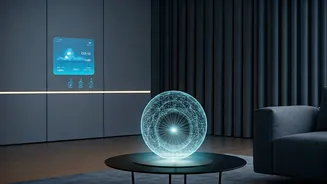









What is a 'Smart' Space Anyway?
Forget the image of a sterile, robotic home from a '90s movie. Today’s smart living space is less about complicated gadgets and more about seamless convenience. At its core, a smart home is one where everyday appliances and systems—like lights, fans,
air conditioners, and security cameras—are connected to the internet. This network, often called the 'Internet of Things' (IoT), allows you to control, automate, and monitor your home remotely using a smartphone app or a simple voice command. It’s the ability to switch off the geyser you forgot about from your office, or ask a smart speaker to dim the lights for a movie, or check on your home through a security camera while on vacation. It’s not one single device, but an ecosystem that works together to make life simpler, safer, and more efficient.
The Perfect Storm for Adoption
So, why is this happening now? Several factors have created a perfect storm for the rise of smart homes in India. Firstly, affordability. The cost of smart devices has plummeted. A smart bulb or plug can now be bought for less than the price of a family pizza. Secondly, connectivity. The widespread availability of cheap, high-speed Wi-Fi has provided the essential backbone for these devices to function. Thirdly, accessibility. Companies like Amazon, Google, and a host of Indian brands like Wipro and Crompton have made smart devices readily available online and offline, often with easy-to-install, DIY-friendly designs. The pandemic also played a role; as people spent more time at home, they invested more in making their living spaces comfortable, functional, and entertaining.
The Entry-Level Upgrades
For most Indians, the journey into smart living doesn’t start with a complete home overhaul. It begins with small, incremental upgrades. The most popular gateway devices are smart speakers like Amazon Echo and Google Nest Hub. They act as a central command unit, allowing users to control other devices with their voice. From there, the expansion is natural. Smart lighting is a huge draw, offering the ability to change brightness and even colour to suit the mood. Smart plugs are another easy entry point, turning any regular appliance—a coffee machine, an old fan, a mosquito repellent—into a smart one. As comfort levels grow, users venture into smart security cameras for peace of mind and app-controlled air conditioners or geysers for energy savings.
Beyond Convenience: Deeper Motivations
While the 'cool factor' is undeniable, the sustained growth of smart homes is fuelled by more practical benefits. For many, energy efficiency is a major driver. A smart AC can learn your cooling preferences and optimise its usage, leading to significant savings on electricity bills. Similarly, scheduling lights and fans to turn off automatically prevents wastage. Security is another powerful motivator. The ability to monitor your front door, receive alerts about motion, and even speak to visitors through a smart doorbell provides a sense of safety that was previously expensive and complex to achieve. For families with elderly parents or young children, smart devices offer a new layer of care, allowing them to check in remotely or simplify daily tasks for their loved ones.
The Road Ahead: Challenges and Dreams
Of course, the path to a fully automated home isn't without bumps. Interoperability remains a challenge; a device from one brand may not always work seamlessly with another. Concerns about data privacy and the security of connected devices are also valid and require consumer awareness. Unreliable internet or power fluctuations, a reality in many parts of the country, can disrupt the 'smart' experience. However, these hurdles are not deterring the dream. As technology matures and becomes more integrated, the question is shifting from 'if' an Indian home will be smart to 'how' smart it will be.