




When we think of space telescopes, we picture the breathtakingly detailed images of distant galaxies and nebulae from Hubble or the James Webb Space Telescope (JWST). But what if a telescope’s goal wasn't a perfect portrait, but a complete map?
A Cosmic Mapmaker, Not a Portrait Artist
The fundamental
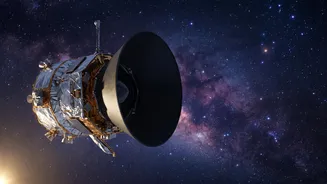
difference between SPHEREx (Spectro-Photometer for the History of the Universe, Epoch of Reionization, and Ices Explorer) and its famous counterparts lies in its strategy. Telescopes like Hubble and Webb are designed for deep, targeted observations. They zoom in with incredible precision on a tiny patch of sky—a specific star, a distant galaxy, or a planetary atmosphere—to study it in exhaustive detail. Over three decades, Hubble has observed just 0.1% of the sky. In contrast, SPHEREx is a survey telescope. Its mission is to scan over 99% of the entire sky every six months, creating a massive, comprehensive map of the cosmos. Instead of a deep dive on one subject, it conducts a wide census of hundreds of millions of objects, creating a dataset of unprecedented breadth.
Seeing the Universe in 102 'Colors'
While Webb and Hubble are primarily imaging instruments that capture stunning pictures, SPHEREx's main tool is a technique called spectrophotometry. Think of it like putting a prism on every single point in the sky. It breaks down the infrared light from every source into its constituent wavelengths, or what we perceive as colors. Specifically, SPHEREx will map the sky in 102 distinct infrared color bands. This is crucial because different chemical elements and molecules absorb and emit light at unique wavelengths, leaving a 'fingerprint' in the spectrum. By analyzing these spectra, scientists can determine an object's chemical composition and, crucially, its distance. This allows them to build their map not just in two dimensions, but in three.
Answering Big-Picture Questions
This all-sky, multi-color map is designed to tackle some of the biggest questions in cosmology that can't be answered by studying one object at a time. The SPHEREx mission has three primary scientific goals. First, it will study the large-scale structure of the universe by mapping the 3D positions of hundreds of millions of galaxies. This will allow scientists to search for the subtle imprints of cosmic inflation, the ultra-rapid expansion of space that occurred less than a second after the big bang. Second, it will trace the history of galaxy formation by measuring the faint, collective glow of all galaxies throughout cosmic history, even those too distant or dim to be seen individually. Finally, SPHEREx will search our own Milky Way galaxy for the building blocks of life—specifically water ice and organic molecules—hidden in the dense clouds of gas and dust where new stars and planets are born.
A Treasure Map for Other Telescopes
SPHEREx, which launched in March 2025, isn't a competitor to telescopes like the James Webb Space Telescope; it's a powerful partner. Its mission is designed to be complementary. By scanning the entire sky, SPHEREx will identify the most interesting and unusual cosmic phenomena. This creates a massive catalog of promising targets that Webb, Hubble, and future observatories can then investigate with their powerful, high-resolution instruments. In essence, SPHEREx is drawing the treasure map, highlighting all the 'X marks the spot' locations across the cosmos. The deep-dive telescopes can then follow that map to go digging for scientific gold. This synergy makes SPHEREx a critical part of NASA's fleet of observatories, enabling a more complete and robust understanding of our universe.