







The Fiery Gauntlet of Re-entry
A spacecraft returning from the Moon doesn't just land; it performs a controlled, high-speed collision with the Earth's atmosphere. The Artemis Orion capsule will hit this invisible wall at nearly 40,000 kilometres per hour (about 25,000 mph). At this velocity,
the air in front of the capsule can't get out of the way fast enough. It compresses, forming a shockwave of plasma with temperatures reaching 2,760 degrees Celsius (5,000 degrees Fahrenheit)—roughly half the temperature of the Sun's surface. This inferno is capable of vaporising any unprotected metal in seconds. There is no backup system for the heat shield; it simply has to work. This single, non-redundant piece of engineering is the only thing protecting the astronauts and the entire mission from catastrophic failure during its most vulnerable phase.
A Sacrificial, Ablative Hero
Unlike the reusable ceramic tiles of the Space Shuttle, which insulated the orbiter, Orion’s heat shield is an 'ablative' one. This means it is designed to burn away in a controlled, predictable manner. The shield is made of a material called Avcoat, composed of silica fibres in an epoxy resin, a system first developed for the Apollo missions. As the shield heats up, the outer layers char and vaporise, turning into gas. This process of ablation carries the intense heat away from the spacecraft. In essence, the shield sacrifices parts of itself to create a protective boundary layer of gas, which pushes the scorching plasma away from the vehicle's structure. It’s a counter-intuitive but brilliantly effective strategy: to survive the fire, you let a part of yourself burn.
The Lunar Challenge: Faster and Hotter
Returning from the Moon presents a much greater thermal challenge than returning from low-Earth orbit (LEO), where the International Space Station resides. A spacecraft coming back from LEO travels at about 28,000 km/h, but a lunar return vehicle like Orion reaches speeds closer to 40,000 km/h. Because kinetic energy is proportional to the square of velocity, this seemingly modest increase in speed results in more than double the energy that must be dissipated as heat. This massive energy load is why the robust, single-use ablative shield was chosen over other systems. It is the only proven technology capable of handling the extreme conditions of a high-speed lunar re-entry, a lesson learned from the Apollo era and refined for Artemis.
Lessons from Artemis I
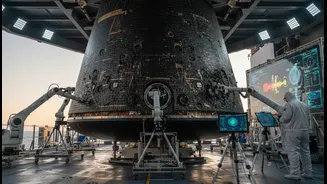
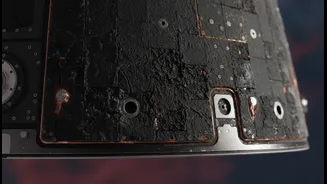
The uncrewed Artemis I mission in 2022 was a crucial test for the entire system, especially the 16.5-foot diameter heat shield. After the capsule's successful splashdown, engineers discovered something unexpected: the heat shield material had charred and broken off in chunks, a phenomenon not fully predicted by models. An intensive, months-long investigation revealed the cause. During a complex 'skip entry' manoeuvre, gases produced within the Avcoat material couldn't escape effectively, causing pressure to build up and pop off pieces of the charred outer layer. While analysis showed a crew would have remained safe, the finding was critical for ensuring the safety of Artemis II. For future missions, NASA is improving the manufacturing process to make the Avcoat more permeable, allowing these gases to vent safely.
Why Students and Fans Should Watch
For engineering students, the Artemis heat shield saga is a real-time lesson in materials science, thermodynamics, and iterative design. The problem discovered on Artemis I—and the engineering response to it—highlights how space exploration pushes the boundaries of our knowledge. It’s a demonstration of how test flights are used to find unknown variables and refine systems to ensure human safety. For space enthusiasts and Artemis followers, paying attention to the heat shield’s performance during re-entry transforms the final moments of the mission from a simple descent into a tense, dramatic proof of technology. It is the ultimate test of decades of engineering, a trial by fire that determines the success of the entire multi-billion-dollar endeavor and paves the way for humanity’s return to the Moon.