

The Anatomy of a Squat
When you perform a squat, you're engaging in a compound movement, which means you're working multiple muscle groups across several joints simultaneously. This is what makes it so efficient. The primary drivers are the large muscles of your upper legs.
The quadriceps, the muscles on the front of your thighs, are heavily engaged as you push back up to a standing position. At the same time, the gluteus maximus (your glutes), the largest muscle in your body, works hard to extend your hips and provide power. The hamstrings, located on the back of your thighs, play a crucial role as well, working with the glutes to control your descent and assist in the upward drive. But it doesn't stop there; squats also fire up your core, as your abdominal and lower back muscles work isometrically to keep your torso stable and upright throughout the movement.
Your Guide to the Perfect Bodyweight Squat
Proper form is crucial to maximise benefits and prevent injury. Forget about speed; focus on control and technique. First, stand with your feet about shoulder-width apart, with your toes pointing slightly outward. Keep your chest up and your gaze forward. Engage your core by bracing your abdominal muscles as if you're about to be lightly punched in the stomach. To start the movement, hinge at your hips and push your buttocks back as if you're aiming for a chair behind you. Continue to bend your knees, allowing your body to lower. Keep your back straight—avoid rounding it. Your goal should be to lower your hips until your thighs are at least parallel to the floor, or as low as your mobility comfortably allows. Ensure your weight is evenly distributed on your feet, perhaps feeling it slightly more in your heels. To stand back up, drive powerfully through your heels, extending your hips and knees to return to the starting position.
Common Mistakes to Avoid
A few common errors can derail your progress. The most frequent is allowing your knees to collapse inward. This puts unnecessary strain on the knee ligaments. To correct this, actively think about pushing your knees outward, keeping them aligned with your feet. Another issue is lifting your heels off the ground, which shifts your weight forward and can stress your ankles and knees. Focus on sitting back and keeping your entire foot planted firmly on the floor. Lastly, avoid rounding your lower back, especially at the bottom of the squat. This often happens when core engagement is lost. Maintain a proud chest and a neutral spine throughout. If you struggle with depth, don't force it. Work within your current range of motion, and it will improve over time.
Progressing Your Squat at Home
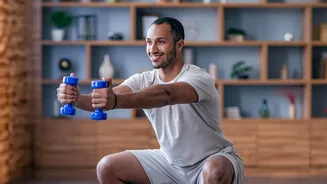
Once you've mastered the basic bodyweight squat, you can introduce variations to continue challenging your muscles. A great next step is the goblet squat. Hold a household object like a heavy book or a jug of water close to your chest. This added weight not only increases the resistance but also acts as a counterbalance, often helping to improve form by encouraging a more upright torso. Another effective variation is the sumo squat, performed with a wider stance and toes pointed further out. This shifts more emphasis to the inner thigh muscles (adductors) and glutes. For a unilateral challenge, which works one leg at a time and improves balance, try the split squat. Place the top of your back foot on a couch or chair and perform a squat with your front leg. These variations ensure you can continue to apply progressive overload—the key to building strength—without needing a gym membership.