
Our Hostile Neighbour
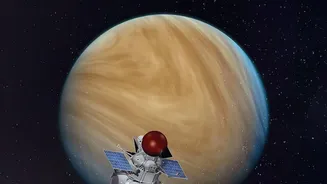
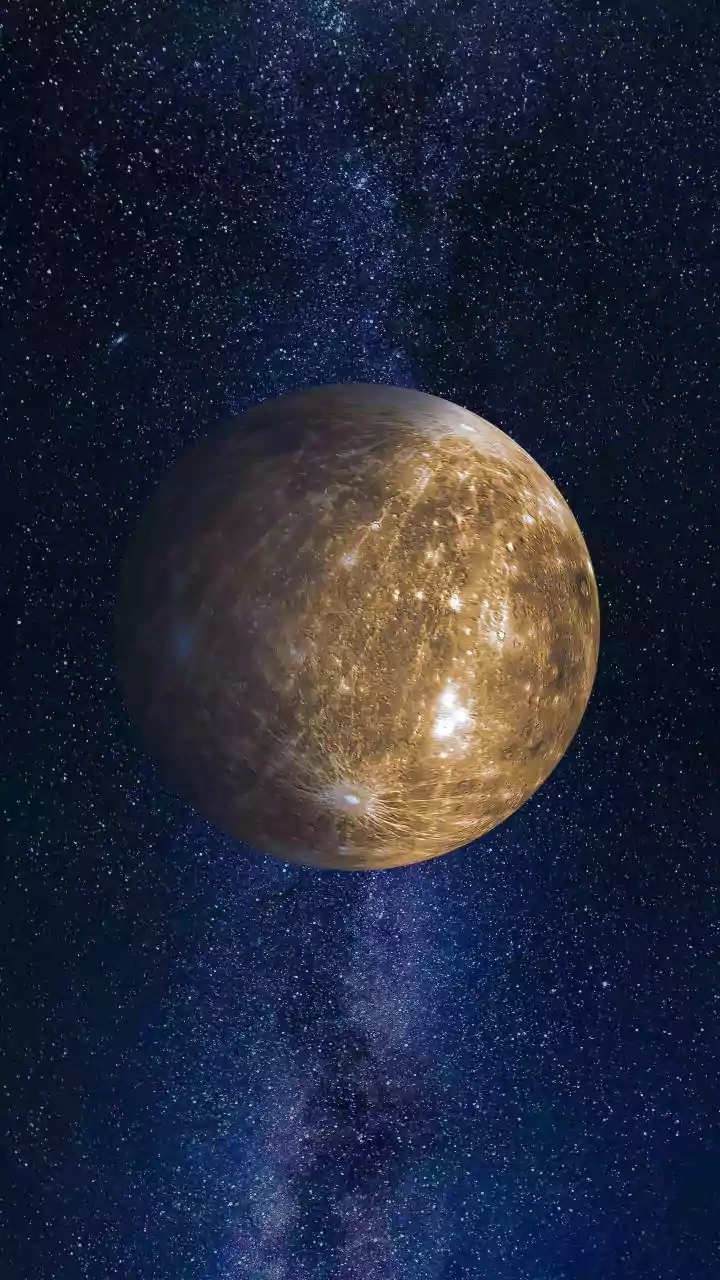
Imagine a planet roughly the same size as Earth, but with a surface hot enough to melt lead and an atmospheric pressure so intense it would crush a submarine. That’s Venus. Its atmosphere, composed of over 96% carbon dioxide with clouds of sulfuric acid,
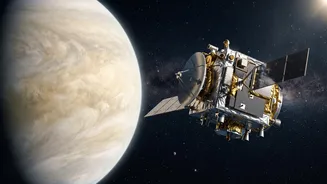
has created a runaway greenhouse effect, trapping heat and making the planet the hottest in our solar system. These impenetrable clouds have long hidden the Venusian surface from conventional telescopes, making it a world of mystery. Landing is incredibly difficult; the longest any craft has survived on the surface is just over two hours. This is the immense challenge that India’s Shukrayaan orbiter mission aims to tackle, not by landing, but by using technology that can see what our eyes cannot.
The Power of Radar Vision
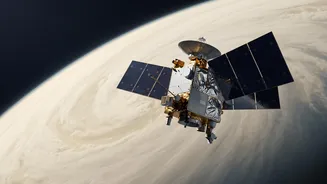
So, how do you map a planet you can't see? The answer lies in radar. Unlike optical cameras that capture reflected light, a Synthetic Aperture Radar (SAR) sends its own radio waves down to the planet's surface. These waves pierce through the dense cloud cover, bounce off the ground, and return to the orbiter. Because the radar can function day or night and in any weather, it is the perfect tool for a perpetually overcast world like Venus. By precisely measuring the time it takes for these signals to return and how they change, scientists can construct a detailed, three-dimensional map of the surface, revealing mountains, volcanoes, and plains hidden for eons.
Shukrayaan’s High-Tech Eyes
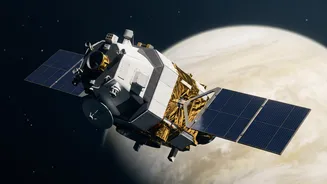
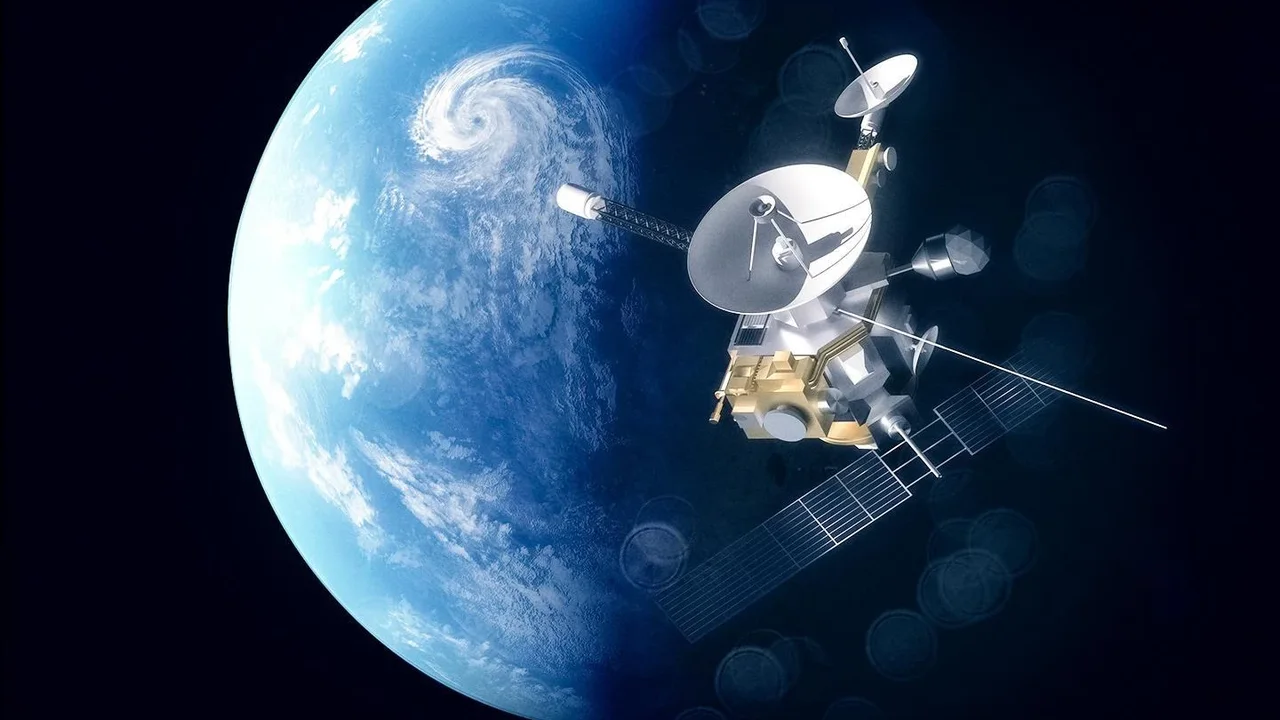
The star instrument aboard Shukrayaan-1 will be a high-resolution Synthetic Aperture Radar (SAR). This isn't just any radar; it's designed to be significantly more powerful than the one on NASA's Magellan mission in the 1990s, promising images with much greater detail. The 'synthetic' part of its name comes from a clever technique. As the spacecraft orbits Venus, the radar captures signals from multiple positions. By combining these signals, it simulates a much larger antenna than it actually has, creating a 'synthetic aperture' that delivers incredibly sharp images. Shukrayaan also plans to carry a ground-penetrating radar, a world-first for Venus, which will probe beneath the surface to study its geological layers.
A Full Scientific Toolkit
While mapping the surface is a primary goal, Shukrayaan is a multi-talented mission. The orbiter is expected to carry around 19 scientific instruments in total, with contributions from international partners like Sweden, Russia, and Germany. These payloads will study a wide range of phenomena. Some will analyze the composition and dynamics of the dense atmosphere, while others will investigate how the solar wind interacts with the Venusian ionosphere. Instruments like the Venus InfraRed Atmospheric Gases Linker (VIRAL), a collaboration with Russia and France, will even investigate the chemistry of the atmosphere for potential biosignatures. This comprehensive suite of sensors ensures the mission will provide a holistic view of the planet, from its subsurface geology to the top of its clouds.
Why Study Earth's 'Evil Twin'?
Understanding Venus is about more than just exploring another planet; it's about understanding our own. Venus and Earth started out as similar 'twin' planets, yet evolved down dramatically different paths. By studying Venus's runaway greenhouse effect, scientists hope to gain critical insights into climate change models here on Earth. The Shukrayaan mission will investigate volcanic activity, the history of its atmosphere, and whether Venus once had liquid water. Answering these questions could reveal crucial lessons about planetary habitability and why Earth remains a sanctuary for life while its twin became so inhospitable. Following the successes of Chandrayaan and Mangalyaan, Shukrayaan represents India's next great leap in planetary science, cementing its role as a major player in deep-space exploration.