




The Lab of the Future is Virtual
Picture a chemistry classroom where students can mix volatile chemicals without any risk of an explosion. Or a biology class where they can shrink down to the size of a cell to witness mitosis firsthand. This isn't science fiction; it's the reality of AI-integrated
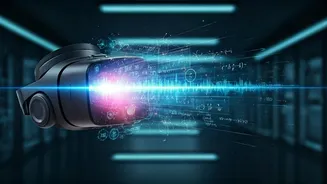
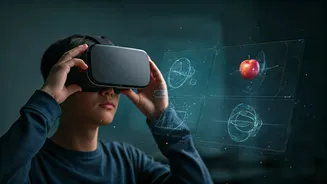
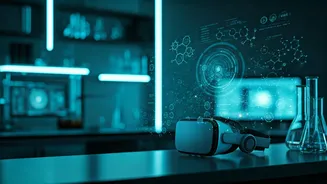
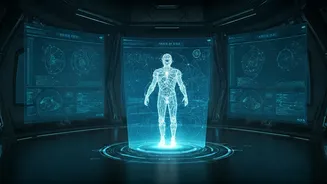
Virtual Reality (VR) classrooms. These platforms create immersive, three-dimensional digital environments that replicate and even enhance traditional science laboratories. Students don a VR headset and are instantly transported into a fully interactive lab. They can see, grab, and manipulate virtual equipment—beakers, bunsen burners, microscopes—just as they would in the real world. But unlike the real world, here they can reset a failed experiment with a click, speed up time to see a plant grow, or explore concepts at a molecular level, offering a level of interaction that physical labs often cannot match.
Where AI Becomes the Teacher
The true game-changer isn't just the VR environment; it's the Artificial Intelligence (AI) engine working behind the scenes. The AI acts as an intelligent, personalised tutor for every student. If a student makes a mistake, like adding the wrong reagent, the AI doesn't just say 'error'. Instead, it can explain *why* it was a mistake, citing the underlying scientific principles. It can ask guiding questions to help the student figure out the correct procedure on their own. This AI can also adapt the difficulty of the experiment based on the student's performance, providing more challenging scenarios for advanced learners or simplified steps for those who are struggling. It collects data on each student's learning patterns, identifying areas of weakness and providing customised feedback, something a single teacher with a class of 40 students would find nearly impossible to do.
Solving India's Education Gap
For a country like India, with its vast and diverse student population, this technology holds immense promise. Many schools, particularly in rural and semi-urban areas, lack the funding for fully equipped, safe, and modern science labs. High-end equipment is expensive to buy and maintain. VR labs democratise access to high-quality science education. A single software subscription can give an entire school access to hundreds of experiments that would otherwise cost lakhs of rupees in physical infrastructure. It addresses the critical issue of safety, allowing students to learn about nuclear physics or dangerous chemical reactions in a completely secure environment. Initiatives like the government's 'Virtual Labs' project, developed by institutions like the IITs, already provide a web-based version of this, and the integration of more immersive VR/AI is the logical next step.
A Richer Learning Experience
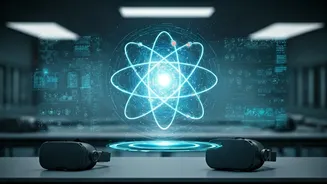
The student experience is transformed from passive observation to active participation. In a traditional physics lab, a student might measure the arc of a projectile. In a VR lab, they can go to the moon and perform the same experiment in a low-gravity environment to truly understand the principles at play. They can visualise abstract concepts like magnetic fields or atomic bonds in 3D, making them tangible and easier to grasp. This hands-on, inquiry-based learning fosters curiosity and a deeper conceptual understanding, moving away from rote memorisation. It prepares students for real-world scientific challenges by teaching them problem-solving and critical thinking in a dynamic, responsive setting.
Challenges on the Road Ahead
Despite the potential, the path to widespread adoption has its hurdles. The initial cost of VR headsets, while decreasing, can still be a barrier for many institutions. Reliable high-speed internet is a must, which remains a challenge in many parts of the country. Furthermore, technology can never completely replace the human element. Teachers will need training not just on how to use the technology, but on how to integrate it into their curriculum effectively. The role of the teacher shifts from being a 'sage on the stage' to a 'guide on the side,' facilitating learning and discussion around the virtual experiences. The goal isn't to replace teachers or physical labs, but to supplement them with a powerful new tool.