


For decades, we’ve been told the universe is being pushed apart by a mysterious force called dark energy. It’s a cornerstone of modern cosmology, but what if it’s wrong? A team of Canadian researchers is putting that very idea to the test.
The Universe's Standard Model
To understand
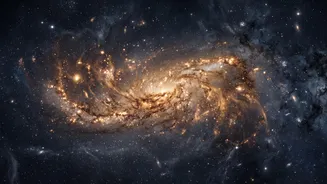
why this is such a big deal, we first need to talk about the reigning champion of cosmic theories: the Lambda Cold Dark Matter (ΛCDM) model. Think of it as the Standard Model for the entire universe. It successfully explains a vast range of cosmic observations, from the faint afterglow of the Big Bang (the Cosmic Microwave Background) to the large-scale structure of galaxies. In this model, 'Lambda' represents dark energy, a constant force that accounts for about 70% of the universe's total energy and is responsible for its accelerating expansion. 'Cold Dark Matter' is an invisible substance making up about 25% of the universe, whose gravity holds galaxies together. The remaining 5% is all the normal matter we can see and interact with. The problem? Neither dark energy nor dark matter has ever been directly detected. They are theoretical necessities that make the equations work.
A Radical New Idea from Ottawa
Enter Adjunct Professor Rajendra Gupta and postdoctoral researcher Dr. Nikolaos Samaras from the University of Ottawa. They are testing an alternative framework that does away with the need for both dark energy and dark matter. Their model is called CCC+TL, which stands for 'Covarying Coupling Constants plus Tired Light'. It's a hybrid theory that proposes two fundamental shifts in our understanding. The 'Covarying Coupling Constants' part suggests that the fundamental forces of nature might not be constant, weakening over cosmic time. The 'Tired Light' hypothesis posits that light loses energy as it travels across vast cosmic distances, which could be misinterpreted as accelerating expansion. Together, these ideas paint a very different picture of the cosmos.
A Much Older Universe
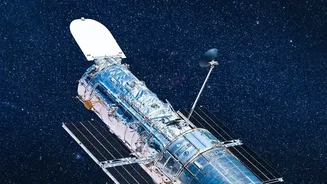
One of the most profound implications of the CCC+TL model is that the universe could be much older than we think. While the standard ΛCDM model calculates the age of the universe to be about 13.8 billion years, Gupta and Samaras's model estimates it to be 26.7 billion years old. This extended timeline could solve some nagging puzzles in cosmology. For instance, the James Webb Space Telescope has observed galaxies in the early universe that appear surprisingly mature and massive for their supposed age. In a 13.8-billion-year-old universe, there might not have been enough time for them to form. But in a 26.7-billion-year-old universe, their existence becomes far more plausible.
Putting the Theory to the Test
A bold new theory is nothing without evidence. Over 2025 and 2026, the Ottawa researchers have been rigorously testing their CCC+TL model against key cosmological observations. They developed entirely new equations and computer code to simulate a universe governed by their rules. The results have been promising. Their model successfully predicts the abundance of light elements like hydrogen and helium created after the Big Bang, matching the predictions of the standard model. In a study of 175 galaxies, they found their framework could explain the rotation of stars and gas without needing to invoke dark matter. They claim the model holds up against multiple major tests, warranting further investigation.
What Happens Now?
The CCC+TL model is still very much an outsider theory and has not yet challenged the scientific consensus. The ΛCDM model remains incredibly successful at explaining the universe on the grandest scales. However, science advances by challenging its own assumptions. The work from the University of Ottawa team represents a fundamental questioning of our cosmic rulebook. While other researchers explore different possibilities, such as dark energy being a property of the quantum vacuum or a sign that Einstein's theory of gravity needs modification, the CCC+TL model offers a unique alternative. The next steps will involve even more stringent tests, particularly against data from the Cosmic Microwave Background, to see if this new vision of the cosmos can truly hold up to scrutiny.