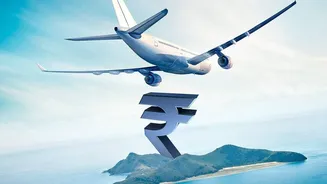







A staggering loss of Rs 10,800 crore for Air India has been estimated by its key partner, Singapore Airlines. But is this colossal figure a sign of trouble, or the calculated cost of one of India's most ambitious corporate turnarounds?
The Eye-Watering Number
The Rs 10,800 crore
figure stems from Singapore Airlines' (SIA) recent financial disclosures for the first half of the 2026-27 fiscal year. As a significant stakeholder in the newly merged Air India entity, SIA is required to account for its share of the Indian carrier's performance. By revealing its own share of the loss—roughly S$361.7 million—it provided the data needed to estimate Air India's total interim loss. This isn't an official report from Air India itself, but an extrapolation based on SIA's books, offering a crucial glimpse into the airline's financial health post-merger with Vistara. While the number is massive, it's notably a slight moderation from the estimated Rs 12,850 crore loss in the same period a year prior, suggesting a complex and evolving financial situation.
Why Singapore Airlines Is Involved
Singapore Airlines is no longer just a codeshare partner; it's family. The long-awaited merger between Vistara (a joint venture between Tata Group and SIA) and Air India was completed on November 12, 2026. This landmark consolidation created a single, full-service carrier under the Air India brand. As part of the deal, Singapore Airlines traded its 49% stake in Vistara for a 25.1% stake in the newly enlarged Air India. This makes SIA a strategic partner in Air India's future and directly ties its financial outcomes to the success of the 'Maharaja'. Therefore, its investor reports now reflect the financial performance, and the losses, of its Indian investment.
The High Cost of a Historic Turnaround
A loss of this magnitude would typically signal deep trouble, but for Air India, it's a reflection of 'spend money to make money'. The Tata Group is undertaking one of the most ambitious turnarounds in aviation history. This involves a complete overhaul of the airline, which had been deteriorating for years under public ownership. The expenses are enormous: a record-breaking order for 470 new aircraft, a $400 million project to refurbish the interiors of the existing fleet, modernization of outdated IT systems, and the establishment of massive new training and maintenance facilities. These are upfront, capital-intensive investments essential for long-term revival, and they are a primary driver of the current losses, as acknowledged by both Tata Sons and SIA.
Tata's Grand Aviation Blueprint
This financial pain is part of a much larger strategy. The Tata Group is consolidating its four airline brands (Air India, Vistara, Air India Express, and AIX Connect) into two: a single full-service carrier (Air India) and a single low-cost carrier (Air India Express). This simplifies operations, creates economies of scale, and allows the group to compete more effectively against domestic leader IndiGo and international giants. The recent merger of Vistara into Air India was the final, and most complex, piece of this structural puzzle. The goal, laid out in the five-year 'Vihaan.AI' transformation plan, is to create a world-class global airline with a significant share of the domestic and international market. The current losses are, in effect, the investment cost of building this new aviation behemoth.
Challenges Beyond the Balance Sheet
While the strategy is clear, the path is fraught with challenges. Integrating the work cultures of four different airlines, particularly the service-oriented ethos of Vistara with the legacy systems of Air India, is a monumental HR task. Furthermore, the airline industry is notoriously difficult, with volatile fuel prices and geopolitical tensions adding constant pressure. Tata Sons Chairman N. Chandrasekaran has recently reset expectations, stating that the full transformation could take five to ten years, longer than the original five-year plan. This acknowledges that rebuilding an airline is about more than just buying new planes; it's about fundamentally changing its operational DNA.
What This Means for Passengers
For the millions who fly Air India, the turnaround is a tale of two timelines. In the short term, there may be operational hiccups as the integration of Vistara's systems, staff, and fleet takes place. However, the long-term promise is significant. The massive investments are aimed directly at improving the passenger experience: new and refurbished cabins, better on-time performance, a more robust network, and a loyalty program, 'Maharaja Club', now strengthened by the inclusion of Vistara's members. The ultimate goal is to restore Air India to its former glory as a premier global carrier that Indians can be proud of, a process that requires both patience and deep pockets.