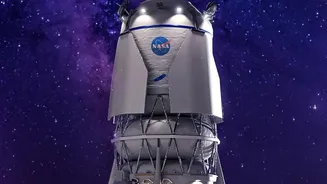








To get astronauts back to the Moon, NASA needs a ride to the surface. Now, the agency is fine-tuning the rulebook for its commercial partners, Blue Origin and SpaceX, reworking the very milestones that define the path to a lunar landing.
What is Changing for Artemis?
NASA is undertaking
a significant restructuring of its Artemis program, the ambitious effort to return humans to the Moon. In a major shift announced in February 2026 and clarified in subsequent updates, the agency has streamlined the designs and altered the operational plans for the Human Landing Systems (HLS) being developed by SpaceX and Blue Origin. Originally, Artemis III was slated to be the first crewed lunar landing since the Apollo era. Now, it has been repurposed as a crucial orbital demonstration mission set for 2027. During Artemis III, astronauts aboard the Orion spacecraft will rendezvous and perform docking tests with demonstration versions of both SpaceX's Starship and Blue Origin's Blue Moon landers in low-Earth orbit. This change pushes the actual crewed lunar landing to the Artemis IV mission, now targeted for 2028.
A Tale of Two Landers
The rework affects both of NASA's commercial partners, but in different ways. For SpaceX, the new plan involves its Starship HLS docking with the Orion crew capsule in high-Earth orbit. The combined stack will then journey to the Moon. This concept relies heavily on SpaceX mastering in-space refueling, a complex process that may require multiple tanker flights to fuel up a Starship depot before the lander can even begin its lunar journey. For Blue Origin, the path to the Moon has also been clarified. Its Blue Moon lander, specifically the Mark 2 variant intended for crew, will use a multi-stage approach for the 2028 landing mission, avoiding the need for in-space propellant transfer for that initial flight. This is seen as a way to reduce risk and accelerate development. Both companies must successfully complete the Artemis III orbital demo and subsequent uncrewed lunar landing tests to prove their systems are safe for astronauts.
Why Rework the Plan?
The primary driver behind this significant rework is a pragmatic effort to increase the chances of success and stick to an aggressive timeline. By targeting a 2028 landing, NASA aims to maintain momentum and stay ahead of other international space programs. The original architecture, which involved a complex lunar rendezvous in a 'near-rectilinear halo orbit', has been simplified for each partner based on their vehicle's specific design. Repurposing Artemis III into an Earth-orbit test flight is a classic risk-reduction strategy. It allows NASA and its partners to test critical rendezvous and docking procedures closer to home before attempting them in deep space. According to NASA's Artemis program manager, every activity on Artemis III is specifically designed to reduce risk for the subsequent landing missions. This adjustment acknowledges the immense technical challenges both SpaceX and Blue Origin face in developing these next-generation landers.
Sustaining a Presence on the Moon
This milestone adjustment isn't just about the first landing; it's about creating a sustainable, long term presence on the Moon. NASA has awarded contracts under a program called Sustaining Lunar Development (SLD), which aims to ensure there is competition and redundancy in its lunar landing capabilities for missions beyond Artemis IV. Blue Origin was selected in May 2023 for this second lander contract, ensuring that NASA wouldn't be reliant on a single provider. The goal is to have at least one lunar landing per year following the initial return. In parallel, both companies are also developing cargo versions of their landers capable of delivering tons of supplies and scientific equipment to the surface, laying the groundwork for a future Moon base.
The Road to 2028
The path to Artemis IV is packed with critical milestones. For SpaceX, this includes demonstrating orbital refueling, which is a linchpin of its entire architecture. For Blue Origin, it involves a series of flights with its smaller, uncrewed Mark 1 lander to gain experience and test systems, along with returning its powerful New Glenn rocket to flight. The Artemis III mission in 2027 will be the first major combined test of the new architecture. Ultimately, NASA has stated that lander readiness will be the deciding factor in which company gets the historic honor of landing the first Artemis crew on the Moon. The race is on, and the next few years will be a period of intense testing and development as NASA and its partners work to turn these revised plans into a reality.