



Reading the Barcode of Light
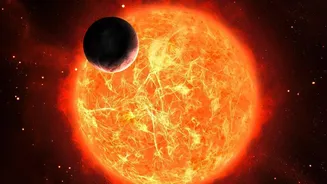
To understand a world hundreds of light-years away, astronomers rely on a clever trick called transmission spectroscopy. It begins when an exoplanet passes in front of its host star from our point of view, an event called a transit. For a brief moment,
the starlight filters through the edge of the planet’s atmosphere. Molecules in that atmosphere, like water vapor or methane, absorb very specific colors, or wavelengths, of that light. By capturing the light before and during the transit, powerful instruments called spectrographs can measure which colors are missing. Each set of missing colors acts like a unique barcode, revealing the chemical fingerprint of the planet’s atmosphere and telling scientists what gases are present.
When Clouds Obscure the View
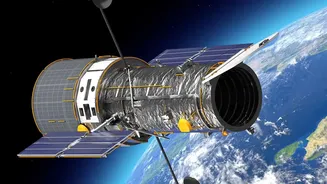
The biggest challenge for this technique is that clouds and hazes can get in the way. Just like a cloudy day on Earth, a thick layer of clouds on an exoplanet can block the starlight from ever reaching the lower atmosphere where most of the interesting chemistry happens. For years, telescopes like the Hubble Space Telescope would capture the light from a transiting exoplanet only to find a flat, featureless spectrum. This told scientists that clouds were present, but it was frustratingly difficult to determine what those clouds were made of or to see the gases hiding beneath them, essentially like trying to read a book through a foggy window.
The Infrared Advantage
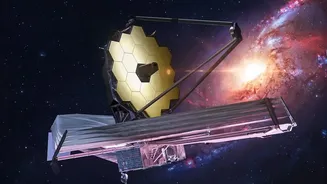
This is where the James Webb Space Telescope (JWST) has been a complete game-changer. JWST is designed to see the universe in infrared light, which has longer wavelengths than the visible light our eyes see. This infrared vision gives it two superpowers for studying cloudy planets. First, longer wavelengths of light are better at penetrating through the fine particles that make up atmospheric hazes, allowing the telescope to peer deeper. Second, JWST’s incredibly sensitive spectrographs can detect the subtle chemical signatures of the cloud particles themselves. Different types of clouds absorb different wavelengths of infrared light, allowing scientists to finally identify their composition.
Clouds of Rock and Sand
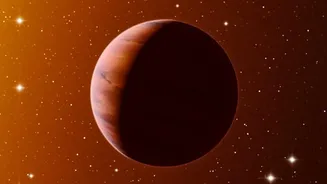
Thanks to JWST, we now know that exoplanet clouds are far more exotic than the water-ice clouds on Earth. On searingly hot 'hot Jupiters' that orbit incredibly close to their stars, scientists have found clouds made of tiny silicate particles—essentially vaporized rock or sand. On the planet VHS 1256 b, located 40 light-years away, JWST detected swirling clouds of silicate dust grains churning in an atmosphere heated to 830 degrees Celsius. In other systems, like YSES-1c, similar silicate clouds were identified in the atmosphere of a young gas giant planet. These discoveries were made by matching the specific way the clouds absorbed infrared light to models of how different minerals behave at extreme temperatures.
A Key to Climate and Habitability
Studying clouds isn’t just about cataloging bizarre forms of weather. On any planet, clouds play a critical role in regulating climate. They can reflect starlight back into space, cooling the planet, or trap heat, warming it up. The presence and composition of clouds are crucial factors in determining whether a rocky exoplanet could maintain a stable enough temperature for liquid water to exist on its surface—a key ingredient for life as we know it. By understanding the daily cloud cycles, as seen on planets like WASP-94A b where sand clouds form in the morning and dissipate by evening, scientists can build more accurate models of planetary climates.