




The Prime Suspects
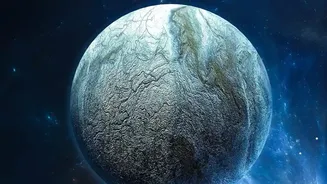
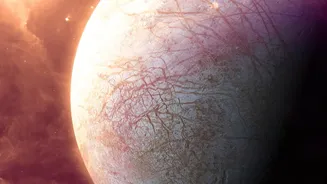
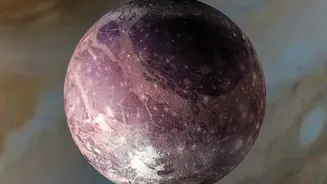
For decades, scientists have dreamt of worlds that could harbour life. While Mars has received much attention, the focus is expanding. Europa and Enceladus have emerged as top candidates because they appear to possess the three key ingredients for life as we
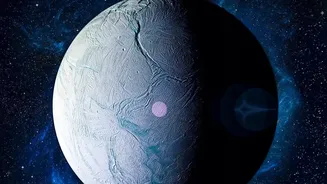
know it: liquid water, essential chemical elements, and a source of energy. Data from past missions like Galileo and Cassini strongly suggest that both moons hide global oceans of salty liquid water beneath their thick, icy shells. On Enceladus, massive geysers even blast plumes of this water into space, offering a tantalising glimpse of the ocean's chemistry without ever having to land.
The Great Ice Barrier
The single biggest challenge is getting to the water. Both moons are covered in a crust of ice thought to be kilometres thick. This shell acts as a protective shield against the harsh radiation from their parent planets, Jupiter and Saturn, which could actually help preserve any potential life within the ocean. But it also presents a formidable barrier. How can you explore an ocean you cannot see or reach? Scientists are developing clever ways to peer beneath this frozen veil, using a combination of remote sensing and, eventually, direct access.
A Toolkit for the Abyss
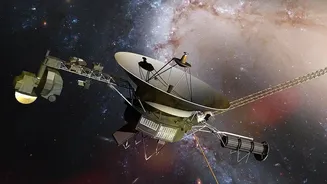
Future missions are being equipped with a suite of sophisticated instruments designed to analyse these hidden worlds from orbit. NASA's Europa Clipper, for example, carries ice-penetrating radar to measure the thickness of the ice shell and locate potential pockets of water. Magnetometers will measure the moon's magnetic field to confirm the ocean's depth and saltiness. Spectrometers will analyse the chemical composition of the surface and any material ejected into space, searching for the tell-tale signs of life, known as biosignatures.
What Are We Looking For?
Finding life won't be as simple as spotting a swimming creature. Instead, scientists are looking for biosignatures—subtle chemical clues that are hard to explain without biology. These could include complex organic molecules like amino acids or fatty acids, a specific ratio of chemical isotopes that life prefers, or an unusual mix of gases. For example, on Earth, marine life produces certain compounds that wouldn't exist otherwise. Detecting similar anomalies in the water plumes of Enceladus or on the surface of Europa could be the first hint of an extraterrestrial ecosystem. However, it's crucial to rule out all non-biological explanations first.
Missions on the Horizon
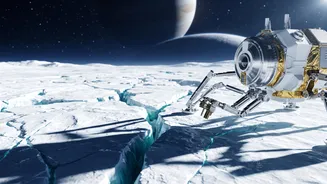
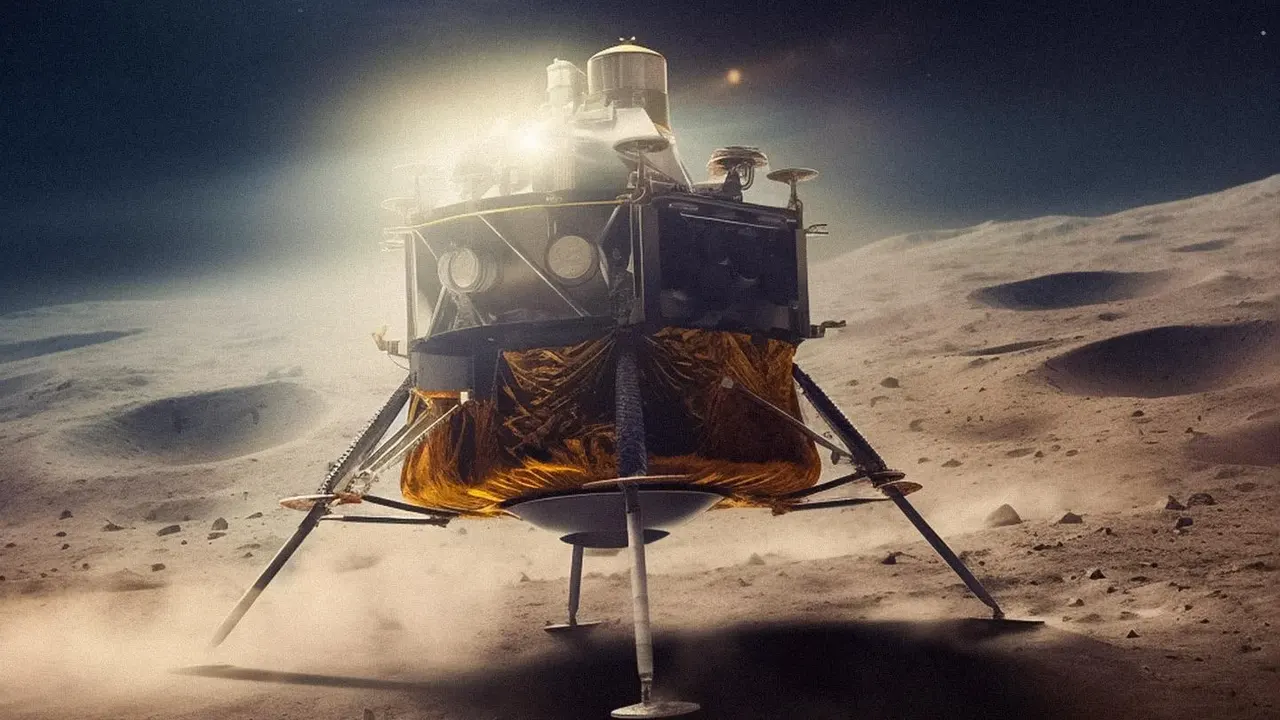
The next two decades are set to be thrilling. NASA's Europa Clipper mission, which launched in 2024, is currently en route to Jupiter and will begin its detailed survey of Europa in 2030. It will perform dozens of close flybys, getting as low as 25 kilometres above the surface to gather unprecedented data. Looking further ahead, both NASA and the European Space Agency (ESA) are planning even more ambitious missions. Concepts like the Enceladus Orbilander propose to first orbit the moon, sampling its plumes, before landing on the surface for a multi-year investigation. China has also expressed interest in a mission to Enceladus. Some long-term concepts even envision cryobots, or melting probes, that could one day drill through the ice to deploy a submersible directly into the alien sea.