




The Landmark Investment
In a significant vote of confidence, Cambridge-based Eka Robotics recently announced it has raised $150 million in a Series A funding round. The round was co-led by prominent venture capital firms Andreessen Horowitz (a16z) and F-Prime, with continued
support from seed investors like Obvious Ventures and E14 Fund. The substantial investment will be used to scale the company's technology, expand its team, and accelerate customer deployments in sectors like manufacturing and warehousing. Founded in 2025 by talent from MIT and Google DeepMind, Eka has quickly attracted attention for its ambitious goal to build general-purpose robots that can perform complex tasks with superhuman speed and reliability.
Beyond Repetitive Actions
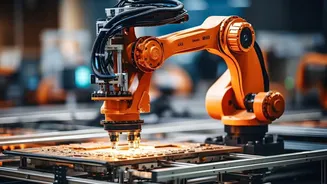
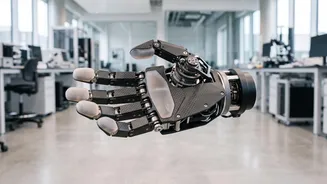
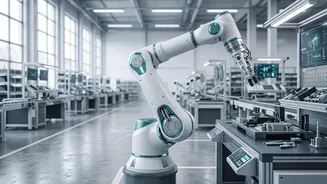
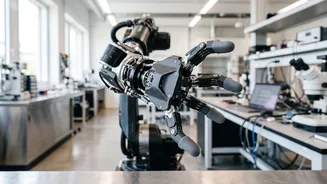
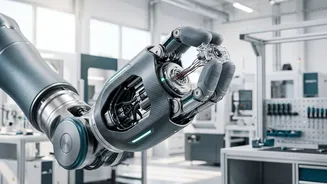
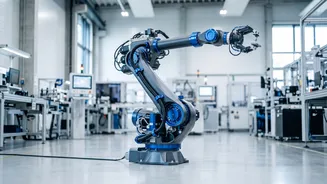
For decades, industrial robots have been masters of repetition. Bolted to the factory floor, they perform a single, pre-programmed task—like welding a specific joint or moving a part from A to B—with tireless precision. This is the world of 'fixed motions'. Eka Robotics is aiming for something fundamentally different: dexterous manipulation. Their focus is on creating robots that can handle variability and unpredictability, much like a human can. This means robots that can pick up delicate objects without crushing them, screw in a lightbulb, or insert wires into a complex assembly—tasks that require a sense of touch and the ability to adapt to changing conditions in real-time.
The Vision-Force-Action Model
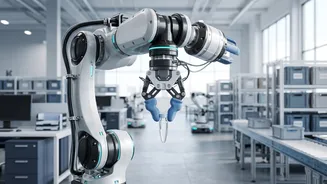
The key to this new generation of robots is what Eka calls its Vision-Force-Action (VFA) model. Instead of just 'seeing' an object with a camera, Eka's robots also 'feel' it using advanced, force-sensitive grippers. This fusion of vision and force feedback allows the robot to develop an intuition for physics. It can sense if a grip is slipping or if a connector is misaligned and adjust its actions accordingly. To teach its robots, Eka doesn't rely on mimicking human actions. Instead, it uses reinforcement learning in vast, simulated environments. In these virtual worlds, the robot can practice a task thousands of times in mere minutes, learning from failures and successes to master the physics of manipulation before ever touching a real-world object.
A New Benchmark for Performance
The results of this approach are already showing superhuman potential. Eka reports its robots can perform pick-and-place tasks at a rate of 1,500 operations per hour, more than double the average human's speed of about 600 per hour, with over 95% accuracy. This leap in performance and versatility addresses a major gap in the automation market. While traditional robots are great for high-volume, structured environments, they struggle with the 'high-mix, low-volume' tasks common in e-commerce, electronics assembly, and food processing. Eka's technology promises to automate the trillions of dollars worth of work that still relies on human hands for its dexterity.
The Indian Context
While Eka Robotics is based in the U.S., its technological leap is highly relevant to India's industrial ambitions. India's robotics market is expanding rapidly, with installations more than doubling between 2021 and 2025, making it the world's sixth-largest installer of industrial robots. Government initiatives like 'Make in India' and the Production Linked Incentive (PLI) scheme are fueling a push for advanced manufacturing. However, much of this growth has been in traditional automation. The introduction of adaptable, AI-driven 'cobots' (collaborative robots) that can work alongside humans is seen as the next major growth wave. The Indian cobot market is forecast to grow at a staggering rate of nearly 30% annually, as industries from automotive to pharmaceuticals seek more flexible and intelligent automation solutions. Technologies like Eka's represent the future that Indian manufacturers will look to adopt to enhance competitiveness.