




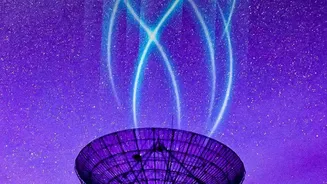
The Universe’s Most Energetic Messengers
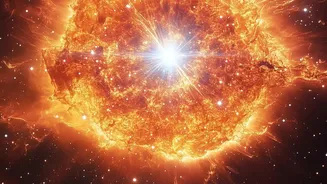
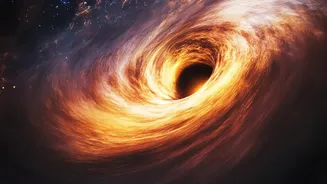
Out in the cosmos, extreme events like exploding stars (supernovae), rapidly spinning neutron stars (pulsars), and the regions around supermassive black holes act as colossal particle accelerators. They fling particles, such as protons and electrons,
and high-energy light, known as gamma rays, across the universe at nearly the speed of light. These cosmic particles are messengers, carrying vital clues about the most powerful phenomena in space. Gamma rays are especially valuable because they travel in a straight line, unaffected by magnetic fields, pointing directly back to their source. However, by the time these particles reach us, they are incredibly difficult to track directly.
Catching a Ghostly Particle
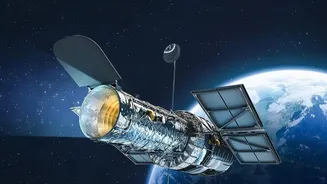
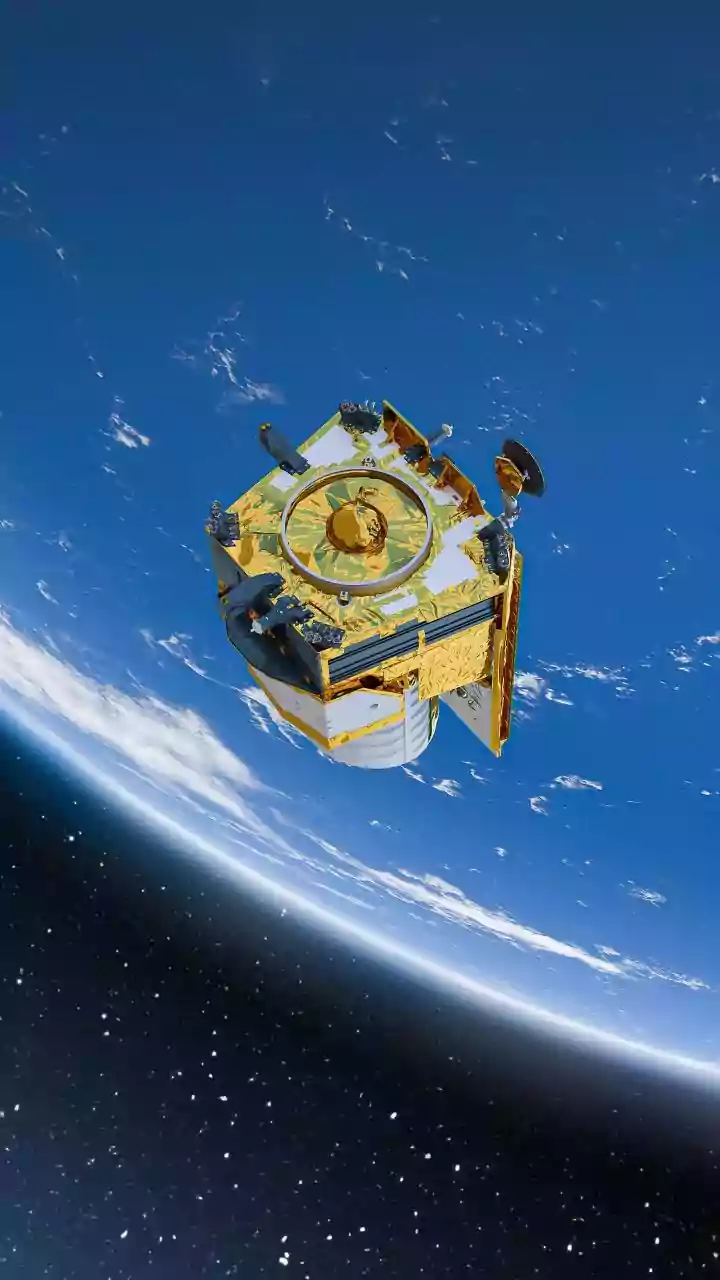
Detecting high-energy gamma rays from Earth's surface is impossible because they are absorbed by our atmosphere. While space telescopes can detect them, they have a major limitation: a small collection area. Catching the rare, highest-energy gamma rays requires a much larger 'net' than any satellite can provide. This is where a clever bit of physics and some truly enormous mirrors come into play. Instead of trying to catch the gamma ray itself, scientists look for its footprint in the atmosphere.
Turning the Sky into a Detector
When a high-energy gamma ray strikes a molecule in the upper atmosphere, it triggers a chain reaction. It annihilates and creates a pair of new particles, an electron and a positron, which continue to collide with air molecules, creating a cascade of secondary particles known as an 'extensive air shower'. Critically, these particles are so energetic that they travel faster than the speed of light in air. This creates an effect analogous to a sonic boom, but with light. The result is an extremely faint, ultrafast flash of blue-violet light called Cherenkov radiation. This ghostly flash, lasting only a few nanoseconds, is the signal scientists are looking for.
Giant Mirrors and Ultra-Fast Cameras
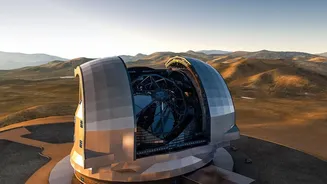
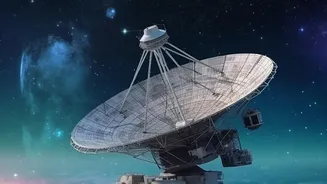
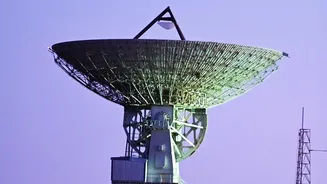
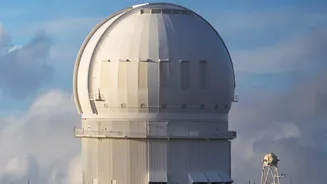
This is where the giant mirrors come in. Observatories known as Imaging Atmospheric Cherenkov Telescopes (IACTs) use huge, segmented mirrors—some as wide as 23 metres—to act like giant light buckets. Their job is to collect the faint Cherenkov light from the air shower and focus it onto incredibly sensitive, high-speed cameras. These cameras, made of photomultiplier tubes, can capture the nanosecond-long flash. The larger the mirror, the more light it can gather, allowing for the detection of fainter events and lower-energy particles. This is why ground-based observatories are essential; building mirrors of this scale for a space mission is not feasible.
Recreating the Cosmic Event
A single telescope provides a 2D image of the air shower. But by using an array of several telescopes in stereo, scientists can get multiple views of the same event. By combining the shape, intensity, and orientation of the light recorded by each telescope, researchers can reconstruct the event in 3D. This allows them to precisely determine the energy and, most importantly, the original arrival direction of the cosmic gamma ray, pinpointing its source in the sky. This technique is used by current observatories like H.E.S.S., MAGIC, and VERITAS, and will be expanded by the next-generation Cherenkov Telescope Array (CTA), which will feature dozens of telescopes across two sites. This enhanced sensitivity will allow it to probe the universe's most extreme environments with unprecedented detail.