

The Ultimate Insurance Policy
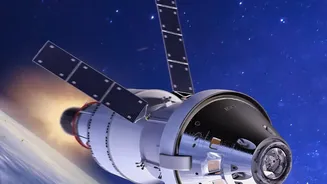
The Crew Escape System, or CES, is a specialised safety mechanism designed for one critical job: to pull the crew module and its astronauts away from the rocket in the blink of an eye if a catastrophic failure occurs during launch. It functions much like
an ejection seat in a fighter jet, but instead of ejecting a single pilot, it propels the entire capsule to a safe distance. The core principle is simple but absolute: the mission can fail, the multi-crore rocket can be lost, but the crew must be brought home safely. An advanced network of sensors, called the Integrated Vehicle Health Management System, constantly monitors the rocket's parameters. If it detects a critical anomaly, the system doesn't wait for a human command—it triggers the abort sequence in milliseconds.
Scenario 1: Trouble on the Launchpad
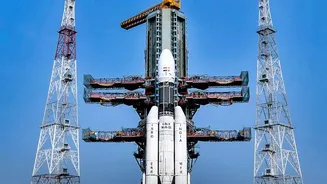
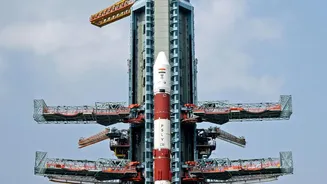
The first major hurdle is getting off the ground. A failure on the launchpad, before the rocket has even lifted off, is a terrifying possibility. To counter this, ISRO developed and successfully tested the Pad Abort Test (PAT) in July 2018. In this scenario, powerful, quick-acting solid motors in the CES ignite to pull the crew module vertically and laterally away from the launch vehicle. These motors are designed to generate immense acceleration—up to 10 times the force of gravity—to outpace any potential explosion on the pad. Once at a safe altitude, the escape system detaches, and a sequence of parachutes deploys to ensure the crew module splashes down softly in the sea for recovery.
Scenario 2: Failure During Ascent
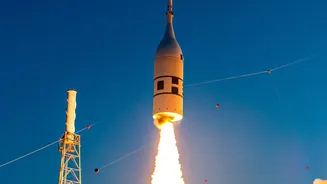
The atmospheric phase of flight, when the rocket is pushing through the air at incredible speeds, is another critical period. To validate safety during this phase, ISRO conducted the Test Vehicle Abort Mission-1 (TV-D1) in October 2023. This test simulated a failure at an altitude of about 17 km while the vehicle was travelling at Mach 1.2, or 1.2 times the speed of sound. This is the point of maximum aerodynamic pressure, a moment of immense stress on the rocket. On a simulated command, the CES successfully fired, pulling the unpressurised crew module away from the test rocket. The entire sequence, from abort to parachute deployment and splashdown in the Bay of Bengal, was executed flawlessly, with the Indian Navy recovering the module.
A Symphony of Safety Systems
The abort system is more than just a single motor; it's a collection of specialised systems working in perfect harmony. Gaganyaan's 'puller' type CES uses a combination of different solid motors, including high-altitude and low-altitude escape motors, as well as pitch motors to steer the capsule away from the rocket's flight path. Following a successful abort, a precise sequence of ten parachutes is deployed to decelerate the crew module. Drogue parachutes first stabilise the capsule at high altitude before the main parachutes open to slow its descent for a gentle splashdown. Even the astronauts' seating position, known as the 'child in cradle' orientation, is designed to help them withstand the intense G-forces of an abort by distributing the force across their bodies.
Building Confidence Through Repetition
A single successful test is not enough to guarantee human safety. The TV-D1 mission was just the first in a series of at least four planned abort tests designed to validate the Crew Escape System under different flight conditions. These repeated, rigorous demonstrations cover various failure scenarios at different altitudes and speeds, ensuring the system is robust and reliable. Each test, from static firing of the escape motors on the ground to complex in-flight aborts, adds another layer of confidence. By meticulously testing every component and sequence, ISRO is systematically proving that every potential failure has been accounted for, building a comprehensive safety net for India's future astronauts.