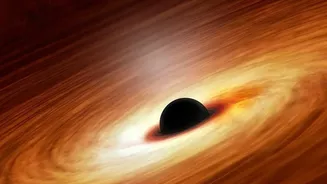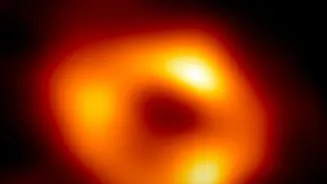







In the cosmic dance of celestial objects, we have witnessed black holes collide and merge. But what about the reverse? The idea of a single black hole splitting in two has long been confined to the realm of science fiction, and we have never seen it happen.
The Fundamental Rule: Why Black Holes Don’t Split
The primary reason a black hole isn't expected to divide comes down to a fundamental law of the universe: the second law of thermodynamics. This principle states that the total entropy, or disorder, of an isolated system cannot decrease. For a non-rotating black hole, splitting into two smaller ones would result in a lower total entropy. Such a process would be 'thermodynamically unfavorable', meaning it goes against the natural direction of physical processes. We observe black holes merging, which increases total entropy, but reversing this process has long been considered a violation of physics. The immense gravity of a black hole also makes it incredibly difficult to imagine any force capable of tearing it apart.
A Search for Theoretical Loopholes
While no observation has ever suggested a black hole can divide, that hasn't stopped physicists from asking, 'what if?'. A recent theoretical study published in the journal Physical Review D did not look for observational evidence, but rather explored the mathematical and physical laws that prevent splitting to see if any loopholes exist. Researchers from institutions including the University of Southern Denmark investigated the extreme conditions under which these barriers might be overcome. Co-author Francesco Sannino explained that the study's goal was to investigate both the laws that normally prevent a split and the specific circumstances that might allow one to happen.
The Crucial Role of Extreme Spin
The study's calculations revealed one potential, albeit extreme, loophole: rapid rotation. If a black hole were spinning at or near its maximum possible speed, the physics changes. This intense rotational energy alters the relationship between the black hole's mass, momentum, and entropy. Under these very specific conditions, the thermodynamic barrier that normally prevents a split could theoretically be overcome, making the division energetically possible. The visual analogy for this theoretical event is described as a 'pair-of-pants topology', where the single event horizon of the original black hole stretches and bifurcates into two separate 'legs', each representing a new, smaller black hole.
A Window That Quickly Closes
Even if a black hole is spinning fast enough to theoretically split, there is another major hurdle. The two newly formed black holes must be able to move apart rather than immediately succumbing to their mutual gravity and merging back into one. According to the researchers, when this requirement is factored in, the window of possibility 'largely closes again'. The only way for the two new black holes to escape each other is if the original was spinning at its absolute physical limit. This makes the scenario incredibly unlikely, confining it to the most extreme and speculative corners of theoretical physics. As Sannino noted, a specific probability for such an event cannot yet be given, as it may depend on physics beyond Einstein's current theory of gravity.
Testing the Limits of the Cosmos
This line of inquiry pushes up against a foundational idea in physics known as the 'cosmic censorship conjecture', proposed by Sir Roger Penrose. This hypothesis suggests that singularities—points of infinite density—must always be cloaked behind an event horizon, preventing them from being 'naked' and influencing the rest of the universe in unpredictable ways. By exploring edge cases like a maximally spinning black hole that could potentially divide, physicists are testing the absolute limits of these cosmic rules. While the recent study doesn't confirm the existence of dividing black holes, it sharpens our understanding of why they are so heavily restricted by the laws of nature, reinforcing just how robust our current models of the universe are.