






A Pipeline Running Dry
For decades, antibiotics have been a cornerstone of modern medicine, turning life-threatening infections into treatable conditions. But their overuse and misuse have accelerated the rise of drug-resistant bacteria, or 'superbugs'. The pipeline for new
antibiotics has slowed to a trickle. The traditional method of discovery—often called 'dirt mining' for screening soil microbes—is slow, costly, and yields diminishing returns. Pharmaceutical companies have found it difficult to justify the massive investment required for development when resistance can develop quickly, making new drugs less profitable. This market failure has contributed to a global health crisis where common infections could once again become deadly.
Enter the Algorithm
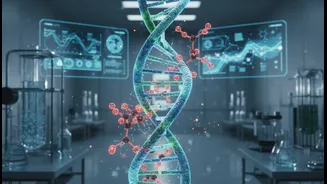
Artificial intelligence, specifically machine learning (ML), is changing the game. Instead of painstakingly testing compounds one by one, scientists can now use AI to screen hundreds of millions of digital chemical structures in days. An ML model is trained on vast datasets of molecules, learning the features that make a compound effective against bacteria. The AI then predicts which other molecules, from enormous virtual libraries, have the highest probability of being successful antibiotic candidates. This process doesn't just find existing molecules; generative AI can even design entirely new ones from scratch, opening up a universe of chemical possibilities that were previously unreachable.
From Digital to Physical
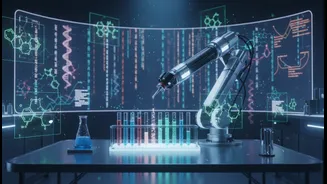
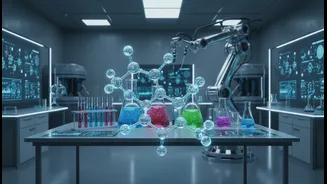
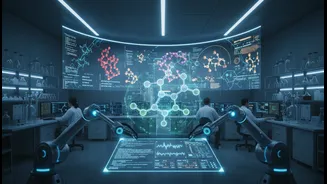
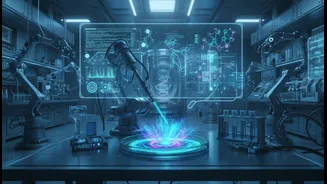
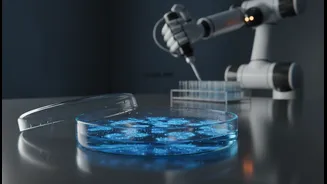
Identifying a promising molecule on a computer is just the first step. This is where chemical optimisation and automated lab assays come in. Once the AI flags a candidate, chemists can digitally tweak its structure to improve its effectiveness or reduce potential toxicity to human cells—a process known as optimisation. Next, these optimised designs are moved from the computer to the lab. Automated lab assays, using robotics, allow for the rapid physical testing of thousands of compounds against actual bacteria. This creates a powerful, high-speed feedback loop: the AI predicts, the robots test, and the results of those tests are fed back into the AI model to make it even smarter for the next round of discovery.
A Glimpse of the Future in Action
This integrated approach is no longer theoretical. Researchers have already used it to identify several powerful new antibiotic candidates. One of the earliest successes was Halicin, a compound identified by an MIT model that showed activity against many resistant bacteria in lab tests. More recently, scientists have used AI to mine the genomes of organisms from around the globe, uncovering nearly a million potential antibiotic compounds. Another AI model identified a new class of compounds capable of killing Acinetobacter baumannii, a superbug classified as an urgent threat. These breakthroughs prove that AI can dramatically accelerate the initial discovery phase, finding novel drug candidates that traditional methods would have missed.
The Road Ahead
While this new technological pipeline is incredibly promising, it is not a magic bullet. Discovering a candidate is a critical but early step in a very long journey. Any new compound must still go through rigorous and expensive preclinical and human clinical trials to prove its safety and efficacy, a process that can take over a decade. The challenges of bringing a drug to market remain significant. However, by supercharging the discovery phase, the combination of machine learning, chemical optimisation, and lab automation provides a vital new strategy. It allows scientists to place more, and better, bets in the crucial fight against antimicrobial resistance, giving humanity a much-needed advantage in this evolutionary arms race.