



The Standard Story of Cosmic Creation
For decades, the prevailing theory of how the universe grew up has been the Lambda-Cold Dark Matter (ΛCDM) model. It’s a grand narrative that has successfully explained many cosmic observations. In this story, the early universe was a relatively smooth,
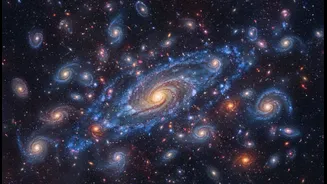
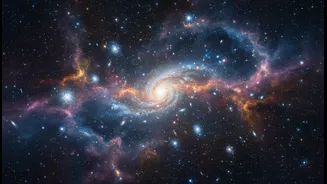
uniform place. Over billions of years, gravity slowly and patiently did its work. Tiny fluctuations in density allowed invisible dark matter to clump together, forming gravitational wells. These wells then pulled in gas, which ignited to form the first stars and small, chaotic proto-galaxies. The model predicts that these infant galaxies were small, messy, and disorganized. Only through countless mergers and collisions over cosmic ages did they gradually assemble into the grand, structured spiral and elliptical galaxies we see today, like our own Milky Way. This bottom-up process is methodical and, most importantly, slow. A galaxy should need billions of years to develop complex features like a rotating disk or a central bar.
A Glimpse into the Cosmic Dawn
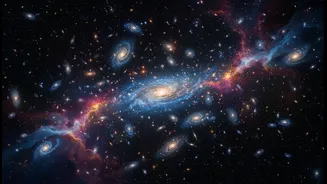
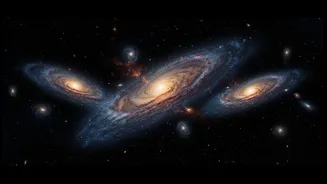
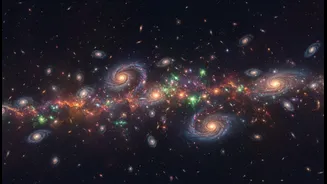
Enter the James Webb Space Telescope (JWST). With its powerful infrared eyes, JWST can peer back in time to the era known as the cosmic dawn, just a few hundred million years after the Big Bang. And what it's finding is shaking the foundations of cosmology. Astronomers are spotting galaxies that existed when the universe was just a fraction of its current age, yet they look shockingly grown-up. Recent discoveries include galaxies with well-defined rotating disks, central bulges, and even spiral arms. One study in July 2026 revealed a galaxy building a complex central structure, known as a nuclear disk, far earlier than any model predicted was possible. These are features that, according to the standard model, should have taken many more billions of years to form. It’s the cosmic equivalent of finding a fully grown oak tree in a garden where you only planted a seed a week ago.
Too Mature, Too Soon
This is the heart of the deepening mystery: the timeline doesn't add up. The discovery of these massive and structured early galaxies presents a direct challenge to the Lambda-CDM model. The universe simply may not have been old enough for gravity to have assembled these structures in the conventional way. Some of these galaxies appear up to 100 times more massive than models predicted for that epoch. It's not just their size; it's their organization. Forming a stable, rotating disk requires time for gas and stars to settle into orderly orbits. Finding them in the chaotic, violent environment of the early universe is deeply puzzling. This tension between theory and observation is forcing scientists to question fundamental assumptions about how the cosmos evolved.
Rewriting the Cosmic Playbook?
So, what could be the answer? Scientists are exploring several possibilities. One idea is that the processes of galaxy formation were simply more efficient and faster in the early universe than they are today. Perhaps the dense conditions allowed gas to turn into stars more rapidly. Another possibility is that some of the brightness and apparent mass of these galaxies could be caused by rapidly growing supermassive black holes at their centres, which would make them look more mature than they really are. More radical ideas are also on the table, with some researchers suggesting that our theories of gravity or dark matter might need revising. The observations are so striking that they have sparked a vibrant debate within the astronomical community, with some calling it a potential crisis for cosmology, while others believe the standard model can be adjusted to fit the new data.